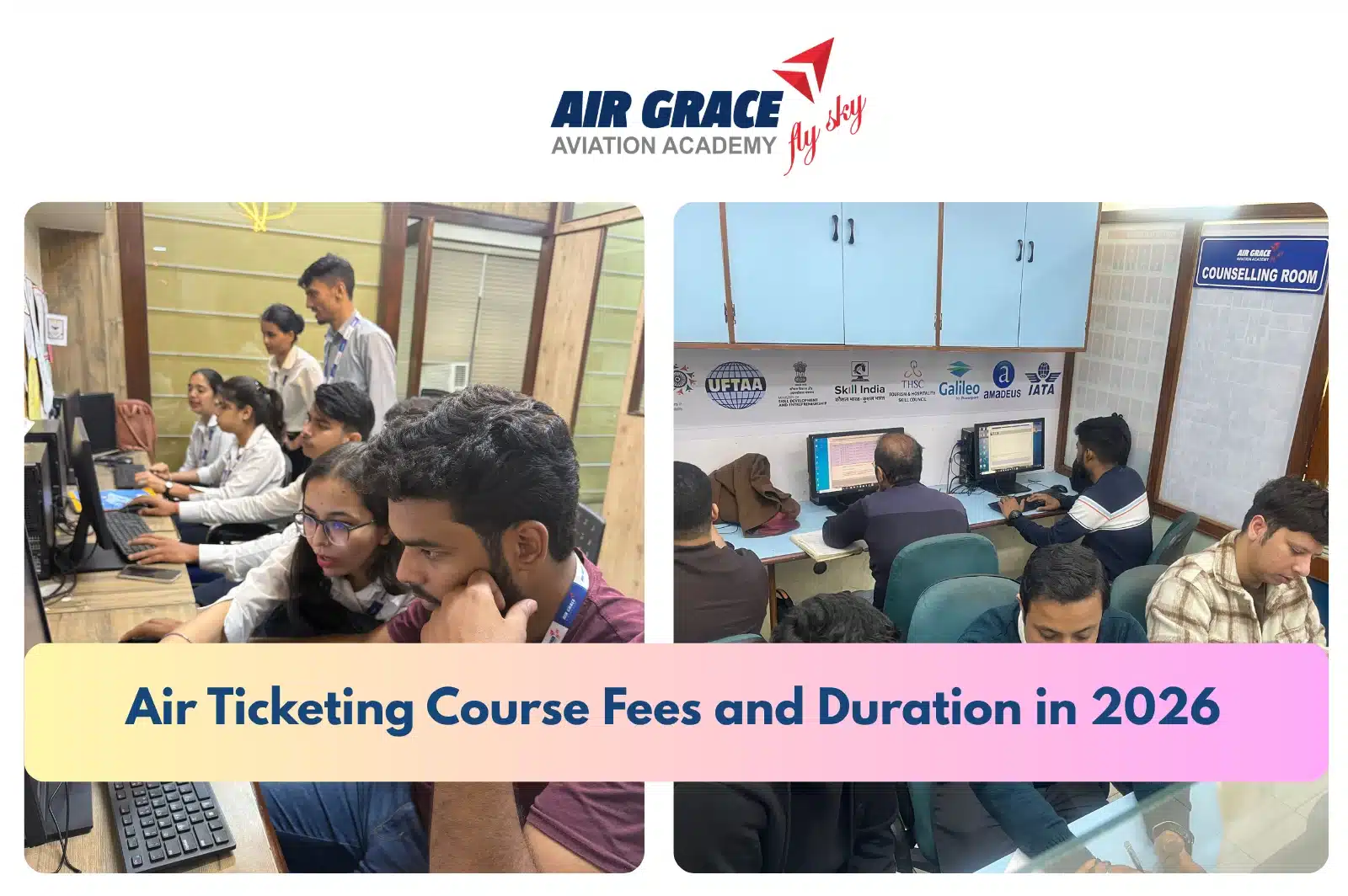
Air Ticketing Course Fees and Duration in 2026
Air Ticketing Course Fees and Duration in 2026 – The aviation and travel industry continues to expand rapidly, creating thousands of job opportunities every year. One of the most popular entry-level programs for aspiring aviation professionals is the Air Ticketing Course. Many students who wish to work in airlines, travel agencies, or airport operations often ask the same question: What are the air ticketing course fees and duration?
Understanding the cost, training period, syllabus, eligibility, and career prospects helps students choose the right institute and program. Air ticketing courses are designed to teach students how airline reservations work, how tickets are issued, how fares are calculated, and how travel documentation is handled.
The good news is that this course does not require several years of study like traditional degrees. In fact, most air ticketing programs can be completed in just a few months, making it one of the fastest ways to enter the aviation industry.
This detailed guide explains everything you need to know about air ticketing course duration, fees, syllabus, eligibility, career scope, and salary prospects so that you can decide whether this course is the right choice for your career.
What is an Air Ticketing Course?
An Air Ticketing Course is a professional training program that teaches students how airline ticketing and reservation systems work. It focuses on the practical aspects of booking flights, managing passenger records, issuing tickets, and handling travel documentation.
In simple terms, air ticketing professionals are responsible for helping travellers book flights and manage their travel arrangements. Whenever you book a flight through a travel agency or airline office, an air ticketing executive processes that booking using specialised airline software.
These programs usually train students on Global Distribution Systems (GDS) such as:
- Amadeus
- Galileo
- Sabre
These platforms are used by airlines and travel agencies worldwide to manage flight reservations and ticketing operations.
The course also teaches essential industry knowledge such as international travel regulations, visa documentation, fare calculations, and passenger handling procedures. Because the aviation industry operates globally, students are also trained in professional communication and customer service.
Many institutes also provide hands-on training with real reservation systems, allowing students to gain practical experience before entering the job market.
Another advantage of the Air Ticketing Course Fees and Duration in 2026 is its flexibility. Air ticketing programs are available as:
- Certificate courses
- Diploma programs
- Fast-track professional training
Students can choose the program that suits their career goals and time availability.
Air Ticketing Course Duration
One of the biggest advantages of enrolling in an air ticketing course is the short training duration compared to many other aviation programs.
The duration depends mainly on the type of course and the depth of training provided by the institute.
Air Ticketing Course Fees and Duration in 2026 – Certificate Air Ticketing Courses
Certificate courses are the most common type of air ticketing program. These courses are designed for students who want to quickly enter the travel and aviation industry.
The typical duration of a certificate course ranges between 3 and 6 months. During this period, students learn the fundamentals of airline ticketing and reservation systems.
Training usually includes:
- Basics of airline ticketing
- Domestic and international flight booking
- Introduction to GDS systems
- Passenger Name Record (PNR) creation
- Fare calculation basics
- Ticket issuance procedures
Because the focus is on practical skills, many institutes conduct computer-based training sessions using airline reservation software.
Certificate courses are ideal for students who want to start working quickly in travel agencies or airline offices.
Fast-Track Air Ticketing Programs
Some aviation institutes offer fast-track air ticketing courses for students who want to complete training quickly.
These programs usually last 1 to 3 months and focus mainly on practical reservation system training.
Fast-track courses are designed for:
- Graduates seeking quick aviation skills
- Working professionals changing careers
- Students who want basic ticketing knowledge
The curriculum typically emphasises:
- GDS software training
- Domestic ticket booking
- Basic international reservations
- E-ticket generation
- Passenger itinerary management
While these programs are shorter, they may not include advanced aviation modules such as airport operations or travel documentation.
However, they are still valuable for gaining entry-level employment in the travel and tourism industry.
Diploma in Air Ticketing and Travel Management
Diploma programs offer more comprehensive aviation training compared to certificate or fast-track courses.
The duration of diploma courses typically ranges from 6 months to 1 year, depending on the institute.
These programs provide deeper knowledge of the aviation and tourism industry and usually include both theoretical and practical training.
Diploma programs may include subjects such as:
- Advanced airline reservation systems
- International ticketing procedures
- Travel and tourism management
- Airport operations
- Customer service and passenger handling
- Visa and passport documentation
- Airline fare construction
Students who complete diploma programs often have better career opportunities because they gain broader industry knowledge.
Many institutes also offer internships or placement assistance as part of diploma courses.
Air Ticketing Course Fees
Another important factor students consider before enrolling is the course fee. The cost of an air ticketing course varies depending on several factors.
These include:
- Reputation of the institute
- Course duration
- Level of certification
- Availability of GDS software training
- Practical training facilities
- Placement support
In India and many other countries, the average fee structure for air ticketing courses falls within an affordable range, making it accessible to a large number of students.
Average Air Ticketing Course Fees
| Course Type | Average Duration | Typical Fees |
|---|---|---|
| Fast Track Course | 1 – 3 Months | ₹15,000 – ₹30,000 |
| Certificate Course | 3 – 6 Months | ₹20,000 – ₹60,000 |
| Diploma Course | 6 Months – 1 Year | ₹50,000 – ₹1,20,000 |
Institutes that provide training on international reservation systems like Amadeus, Galileo, or Sabre may charge higher fees because these software systems require licensed access.
Some institutes also include additional training modules, which can increase the course fee.
Examples include:
- Airport ground handling
- Travel and tourism management
- Personality development
- Interview preparation
Many institutes also offer instalment payment options or educational loans, making the program more affordable for students.
Subjects Covered in an Air Ticketing Course
A well-designed air ticketing course covers both technical and customer service aspects of the aviation industry.
Students learn not only how to issue tickets but also how to manage passenger information and travel documentation.
Some of the most important topics included in the curriculum are listed below.
Airline Reservation Systems
One of the core components of the course is training in Global Distribution Systems (GDS).
These systems are used by airlines and travel agencies worldwide to manage bookings and reservations.
Popular GDS platforms include:
- Amadeus
- Galileo
- Sabre
Students learn how to search flights, create reservations, issue tickets, and modify bookings using these platforms.
Passenger Name Record (PNR) Management
A Passenger Name Record (PNR) is the digital record that contains all travel details for a passenger.
Students learn how to:
- Create PNR records
- Modify passenger details
- Add travel services
- Generate itineraries
Understanding PNR management is essential for anyone working in airline ticketing.
Fare Calculation and Ticket Issuance
Another key skill taught in the course is airfare calculation.
Students learn how ticket prices are determined based on several factors, such as:
- Travel distance
- Airline policies
- Seasonal pricing
- Taxes and surcharges
Once the fare is calculated, the ticket is issued through the reservation system.
Travel Documentation and Regulations
International travel requires proper documentation. Air ticketing courses teach students about:
- Passport requirements
- Visa procedures
- International travel regulations
- Immigration rules
This knowledge ensures passengers have the correct documents before travelling.
Customer Service and Passenger Handling
Because aviation is a service-based industry, customer service skills are extremely important.
Students learn how to:
- Communicate with passengers
- Resolve booking issues
- Handle cancellations and refunds
- Assist travellers with itinerary planning
Strong customer service skills help ticketing professionals build long-term relationships with clients.
Eligibility Criteria for Air Ticketing Course
One of the reasons this course is so popular is that the eligibility requirements are simple and accessible.
Most institutes accept students from any academic background.
The basic eligibility criteria generally include:
- Minimum education: 10+2 (12th pass)
- Basic computer knowledge
- Basic English communication skills
Students from the Arts, Commerce, or Science streams can all pursue this course.
Some institutes may conduct a simple interview to assess communication skills, especially if the course includes airline customer service training.
Because the course focuses on practical skills rather than academic theory, many students find it easier to learn and complete successfully.
Career Opportunities After the Air Ticketing Course
Completing an air ticketing course opens the door to multiple career opportunities in the aviation and travel industry.
Graduates can work in several sectors, including airlines, travel agencies, tour companies, and online travel platforms.
Some of the most common job roles include:
- Air Ticketing Executive
- Travel Consultant
- Reservation Agent
- Tour Coordinator
- Customer Service Executive
- Airport Ground Staff
Travel agencies and airline offices constantly require trained professionals who understand reservation systems and airline policies.
The rapid growth of online travel platforms such as MakeMyTrip, Expedia, and Booking.com has also increased demand for ticketing specialists.
Salary After Completing an Air Ticketing Course
The salary for air ticketing professionals varies depending on experience, location, and employer.
Entry-level candidates typically earn between ₹20,000 and ₹30,000 per month in India.
With experience and specialisation in advanced reservation systems, professionals can earn ₹40,000 to ₹70,000 per month or more.
International airlines and global travel companies may offer even higher salaries along with benefits such as:
- Travel discounts
- Incentives and commissions
- Performance bonuses
- Career advancement opportunities
Over time, professionals can move into senior roles such as Travel Manager, Airline Supervisor, or Aviation Operations Manager.
Conclusion
The Air Ticketing Course is one of the most practical and career-oriented programs for students interested in the aviation and travel industry. With a relatively short training period and affordable fees, it provides an excellent opportunity to start a professional career quickly.
Most air ticketing courses last between 3 and 6 months, while diploma programs may extend up to 1 year for more advanced training. The course fees typically range from ₹15,000 to ₹60,000 for certificate programs and ₹50,000 to ₹1,20,000 for diploma programs, depending on the institute and the training modules included.
Students gain valuable skills in airline reservation systems, ticket issuance, fare calculation, and passenger handling, making them job-ready for roles in airlines, travel agencies, and tourism companies.
For individuals who are passionate about travel, aviation, and customer service, an air ticketing course can be the first step toward a rewarding career in the global aviation industry.
Air Ticketing Course Fees and Duration in 2026 – Frequently Asked Questions (FAQs)
1. What is the duration of an air ticketing course?
The duration typically ranges from 1 to 6 months for certificate programs and from 6 to 1 year for diploma courses.
2. What are the average air ticketing course fees?
Fees usually range from ₹15,000 to ₹60,000, while advanced diploma programs may cost up to ₹1,20,000, depending on the institute.
3. Is the air ticketing course difficult?
No, the course is relatively easy because it focuses mainly on practical training using airline reservation systems.
4. Can I join an air ticketing course after 12th?
Yes, most institutes require only a 10+2 qualification, and students from any stream can enrol.
5. Which software is taught in air ticketing courses?
Students usually learn Amadeus, Galileo, and Sabre, which are the most widely used airline reservation systems worldwide.
At Air Grace Aviation Academy, we provide the best-in-class Air Ticketing, GDS and Airline Ticketing training with the lowest fees. Our trainers are certified by the National Skill Development Council (NSDC), Skill India, under the Government of India. You can always validate our trainer’s certification by scanning the QR Code on the certificate.
We always put in the effort to provide world-class training which emphasises and nourishes our students’ careers.
Please call us on Phone: 085274 46364
Address: 5th Floor, 514, Barakhamba Rd, Connaught Place, New Delhi, Delhi 110001
You can also fill out the form. We will call you shortly!