Understanding the Key Difference in International Air Ticketing
One of the most important concepts in international air ticketing is understanding the difference between IATA Fares and Carrier Fares. The topic of IATA Fares vs Carrier Fares is essential if you want to make sense of fare rules and pricing.
Many students learning air ticketing, fare construction, GDS systems, and international reservations often confuse these two fare types because both are used in airline pricing. However, they serve different purposes and are applied differently within the aviation industry.
Whether you’re preparing for an air ticketing career, learning international fare calculations, or studying airline reservation systems, understanding IATA Fares vs Carrier Fares is an essential skill.
Why Fare Knowledge Matters in Air Ticketing
When passengers search for flights, they usually see only the final ticket price.
Behind that price, however, airlines use various fare structures, rules, routing systems, and pricing methods.
Professional ticketing executives must understand:
- How fares are created
- Who controls the fare
- Where the fare can be applied
- Which fare provides flexibility
- How pricing affects itinerary construction
This is where IATA Fares and Carrier Fares become important.
What Are IATA Fares?
IATA Fares are standardized fares developed in accordance with international fare-construction principles used in the aviation industry.
Historically, these fares helped establish consistent pricing structures across multiple airlines and international routes.
Characteristics of IATA Fares
| Feature | Description |
|---|---|
| Industry-Based | Developed using industry standards |
| Multi-Airline Application | Suitable for interline travel |
| Global Fare Structure | International routing support |
| Standardized Rules | Consistent pricing principles |
| Complex Itineraries | Often used in international journeys |
IATA fares are particularly useful when an itinerary involves multiple airlines operating under coordinated fare agreements.
What Are Carrier Fares?
Carrier Fares are fares created directly by individual airlines.
These fares are designed according to each airline’s commercial strategy, market demand, competition, and revenue objectives.
Characteristics of Carrier Fares
| Feature | Description |
|---|---|
| Airline-Controlled | Set by individual carriers |
| Competitive Pricing | Market-driven |
| Promotional Flexibility | Frequent discounts |
| Route-Specific | Designed for targeted markets |
| Revenue Optimization | Supports airline sales goals |
Today, most airlines rely heavily on carrier fares to remain competitive.
IATA Fares vs Carrier Fares: Quick Comparison
Understanding the distinction becomes easier when viewed side by side.
Comparative Analysis
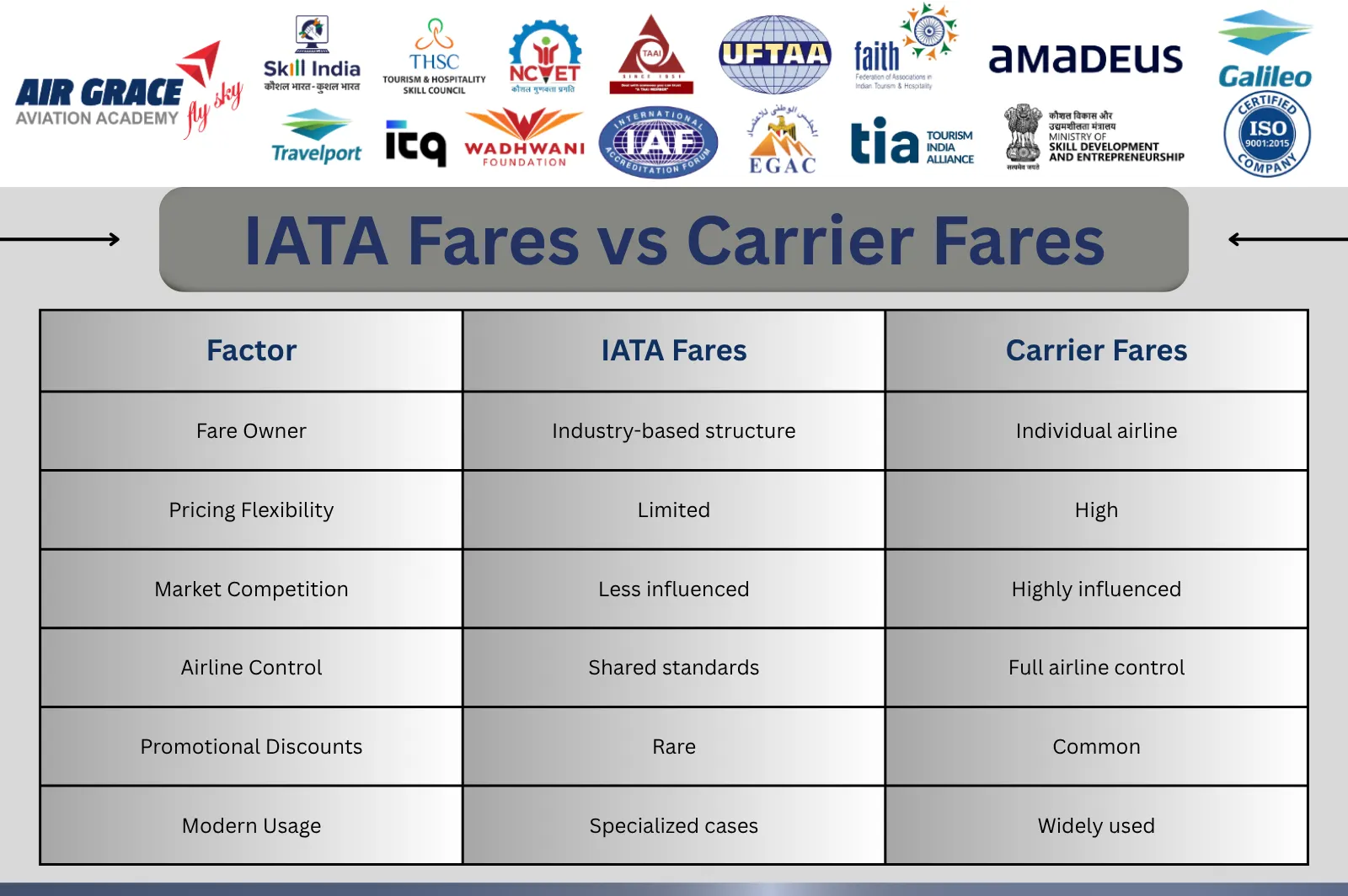
| Factor | IATA Fares | Carrier Fares |
|---|---|---|
| Fare Owner | Industry-based structure | Individual airline |
| Pricing Flexibility | Limited | High |
| Market Competition | Less influenced | Highly influenced |
| Airline Control | Shared standards | Full airline control |
| Promotional Discounts | Rare | Common |
| Modern Usage | Specialized cases | Widely used |
This comparison helps ticketing professionals determine which fare structure applies to a specific booking.
Why Airlines Prefer Carrier Fares Today
The airline industry has become increasingly competitive.
Airlines constantly adjust pricing based on:
- Seasonal demand
- Route performance
- Competitor pricing
- Load factors
- Marketing campaigns
- Passenger behavior
Carrier Fare Advantages
| Business Objective | Benefit |
|---|---|
| Dynamic Pricing | Revenue growth |
| Market Adaptation | Competitive advantage |
| Promotional Sales | Increased bookings |
| Route Expansion | Market penetration |
| Customer Segmentation | Better targeting |
These factors explain why carrier fares dominate modern airline pricing.
Where IATA Fares Are Still Relevant
Although carrier fares are more common today, IATA fare principles remain important in international ticketing.
Situations Where IATA Fare Knowledge Helps
| Ticketing Scenario | Importance |
|---|---|
| Complex International Routing | High |
| Multi-Airline Journeys | High |
| Fare Construction Training | High |
| Air Ticketing Education | Essential |
| Advanced GDS Learning | Valuable |
Students studying international ticketing often encounter these concepts during professional training.
Example: How Fare Logic Differs
Imagine a traveler flying from Delhi to Toronto.
Possible Pricing Approaches
| Scenario | Fare Source |
|---|---|
| Standardized Multi-Airline Journey | IATA Fare Principles |
| Airline Promotional Fare | Carrier Fare |
| Seasonal Discount Offer | Carrier Fare |
| Special Route Combination | May Use Fare Construction Rules |
This demonstrates why ticketing professionals need to understand both systems.
Skills Developed by Learning Fare Structures
Fare knowledge goes beyond ticket pricing.
Professional Benefits
| Skill | Career Advantage |
|---|---|
| Fare Interpretation | Better ticketing accuracy |
| Pricing Analysis | Improved customer guidance |
| Itinerary Planning | Stronger reservation skills |
| Airline Rule Understanding | Professional confidence |
| GDS Navigation | Operational efficiency |
These abilities are highly useful in travel agencies and airline reservation environments.
Why This Topic Is Important for GDS and Air Ticketing Students
Students learning Amadeus, Galileo, international ticketing, and airline reservations often focus on booking procedures.
However, understanding fair logic provides deeper industry knowledge.
Knowledge Progression
| Learning Level | Focus Area |
|---|---|
| Beginner | Flight bookings |
| Intermediate | Reservation management |
| Advanced | Fare construction |
| Professional | Complex itinerary pricing |
This progression helps students become more valuable travel professionals.
Growing Demand for International Ticketing Expertise
As international travel continues to expand, employers increasingly value candidates who understand fare systems and ticketing concepts.
Industry Areas Where Fare Knowledge Matters
| Sector | Application |
|---|---|
| Travel Agencies | Ticket issuance |
| Airlines | Fare management |
| Corporate Travel | Cost optimization |
| Tour Operations | Package pricing |
| Reservation Centers | Booking support |
Understanding fare structures can help professionals handle complex travel requests more effectively.
Learn Air Ticketing Concepts at Air Grace Aviation Academy
Air Grace Aviation Academy introduces students to key aviation topics, including fare structures, international ticketing, reservation procedures, airline terminology, and travel industry operations.
Training Highlights
✔ Air Ticketing Fundamentals
✔ International Fare Concepts
✔ Reservation Procedures
✔ Airline Industry Knowledge
✔ GDS Awareness
✔ Travel Documentation
✔ Interview Preparation
✔ Placement Assistance
Students gain practical knowledge designed to support long-term career development.
Why Students Across Delhi NCR Choose Air Grace Aviation Academy
Students from Connaught Place, Rajiv Chowk, Janpath, Barakhamba Road, Karol Bagh, Janakpuri, Dwarka, Laxmi Nagar, Noida, Ghaziabad, Gurgaon, Faridabad, and surrounding areas choose Air Grace Aviation Academy for industry-oriented aviation training.
Contact Air Grace Aviation Academy
📞 Call Now: 085274 46364
🌐 Website: www.airgraceacademy.com
Fill the form below to book a free career counseling session!
✈ Learn Air Ticketing Beyond Basic Reservations
🌍 Understand International Fare Systems
🎯 Develop Advanced Travel Industry Knowledge
💼 Prepare for Aviation & Travel Careers
Admissions Open – Limited Seats Available!
Start building your expertise in airline ticketing and travel operations with Air Grace Aviation Academy.
Frequently Asked Questions
What is the difference between IATA Fares and Carrier Fares?
IATA Fares follow industry-based fare construction principles, while Carrier Fares are created and controlled directly by individual airlines.
Which fare type is more commonly used today?
Carrier Fares are more commonly used because airlines prefer flexible pricing strategies.
Why should air ticketing students learn fare structures?
Understanding fare structures helps students interpret pricing, manage complex itineraries, and improve ticketing accuracy.
Are IATA Fares still relevant?
Yes. IATA fare concepts remain important for international ticketing education and advanced fare construction.
Is in-depth knowledge important for GDS training?
Yes. Fare interpretation is a valuable skill for students learning reservation systems and international ticketing.

Related posts
Types of EMDs
Understanding Electronic Miscellaneous Documents (EMDs) in Modern Airline Ticketing The airline industry has evolved far …

International Ticketing Training
Learn Global Airfare Systems, International Routing & Worldwide Travel Reservations Every international flight ticket …