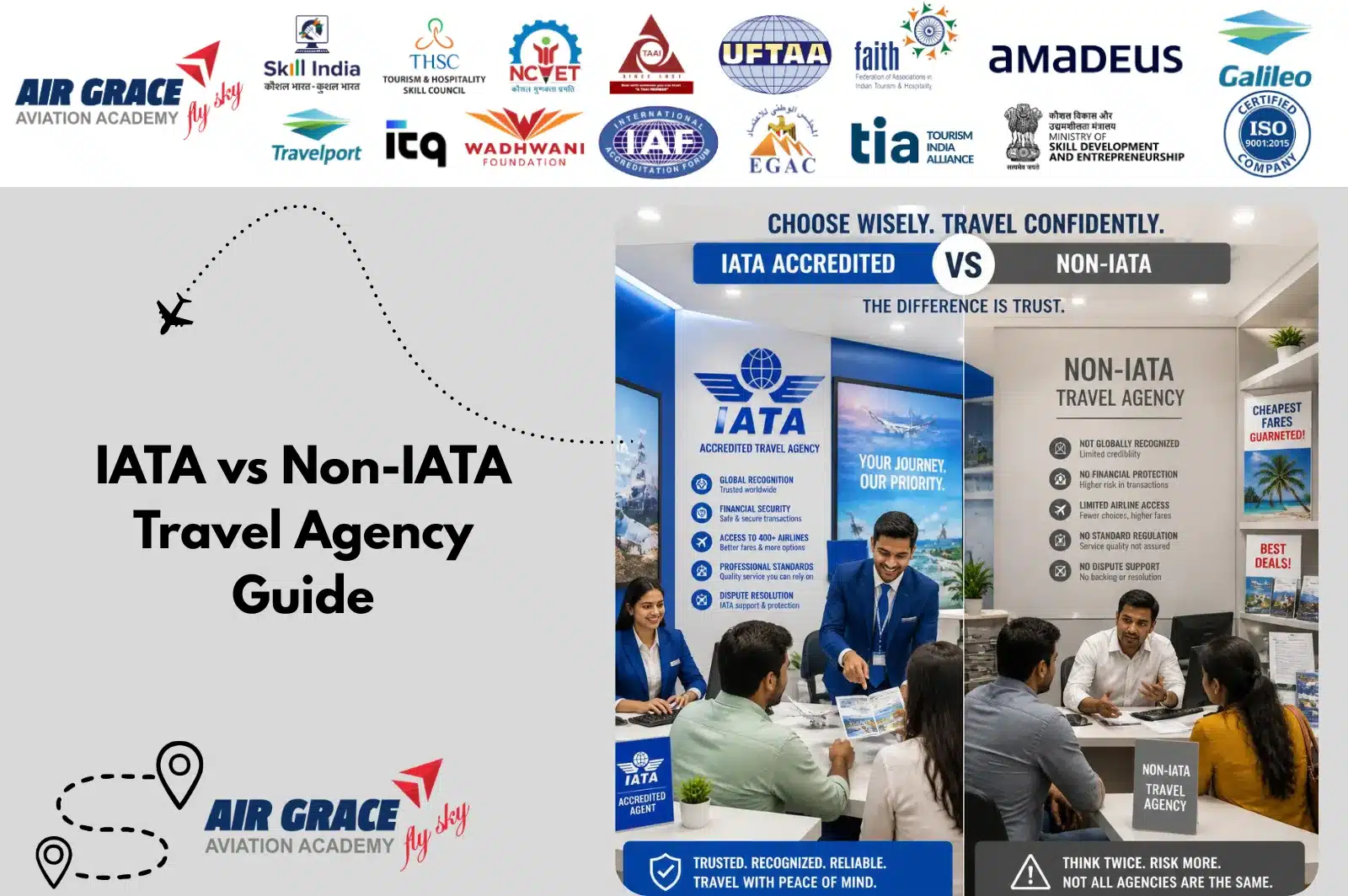
Starting a travel agency is one of the most exciting opportunities in today’s growing tourism and aviation industry. However, one question confuses almost every aspiring travel entrepreneur: what are the differences when it comes to IATA vs Non-IATA Travel Agency options?
Should I start as an IATA travel agency or a Non-IATA travel agency?
Understanding the difference between these two business models is essential before investing your time and money. The choice you make can influence your business operations, partnerships, growth strategy, and long-term goals.
Many successful travel businesses begin as Non-IATA agencies and later progress toward IATA Accreditation as they expand. Others may decide that a Non-IATA model is sufficient for their business objectives. The right path depends on your services, customer base, business scale, and plans.
In this comprehensive guide, you’ll learn:
- What is an IATA travel agency?
- What a Non-IATA travel agency is.
- How both business models operate.
- The major differences between them.
- Advantages and limitations of each.
- Which model is better for beginners?
- How to transition from a Non-IATA agency to an IATA-accredited agency.
- The role of IATA GoLite, GoStandard, and GoGlobal.
Whether you’re planning to start a travel agency in Delhi, Mumbai, Bengaluru, Hyderabad, Chennai, or anywhere in India, this guide will help you understand the options available and make an informed decision.
Understanding IATA
The International Air Transport Association (IATA) is a global trade association for the airline industry. It works with airlines and travel professionals to develop common standards, improve operational efficiency, and support the safe and reliable movement of passengers and cargo.
One of IATA’s important roles is offering accreditation programs for eligible travel agencies that meet its requirements.
For many travel businesses, obtaining IATA accreditation is an important milestone that demonstrates professionalism and industry recognition.
What Is an IATA Travel Agency?
An IATA Travel Agency is a travel agency that has successfully obtained the appropriate IATA accreditation after meeting the applicable eligibility requirements.
IATA-accredited agencies are recognized within the global travel ecosystem and may be able to access various industry programs, tools, and opportunities, depending on the type of accreditation they hold and applicable market rules.
Many established travel agencies choose IATA accreditation as part of their long-term business growth strategy.
What Is a Non-IATA Travel Agency?
A Non-IATA Travel Agency is a travel business that operates without IATA accreditation.
This does not mean the agency is illegal or unprofessional.
In fact, thousands of successful travel agencies around the world operate as Non-IATA agencies.
These agencies commonly:
- Book airline tickets through consolidators or wholesalers.
- Sell domestic and international holiday packages.
- Arrange hotel reservations.
- Provide visa assistance.
- Offer travel insurance.
- Organize corporate travel.
- Manage customized travel itineraries.
For many startups, operating as a Non-IATA agency is a practical way to enter the travel industry while gaining experience and building a customer base.
Why Do Most New Travel Agencies Start as Non-IATA?
Many entrepreneurs begin with a Non-IATA model because it generally requires fewer operational commitments than pursuing accreditation immediately.
Some common reasons include:
- Lower startup investment.
- Simpler business setup.
- Ability to build industry experience.
- Opportunity to establish supplier relationships.
- Time to understand airline reservation systems.
- Flexibility to expand gradually.
As the business grows, some agencies evaluate whether obtaining IATA accreditation aligns with their future goals.
How Do IATA and Non-IATA Travel Agencies Work?
Although their business models differ in some respects, both types of agencies aim to help customers plan and book travel.
Typical services include:
- Flight reservations.
- Hotel bookings.
- Holiday packages.
- Visa guidance.
- Travel insurance.
- Group travel.
- Corporate travel management.
- Cruise bookings.
- Car rentals.
The main operational difference is how airline ticketing and supplier relationships are managed, rather than the range of services offered to customers.
IATA vs Non-IATA Travel Agency: Quick Comparison
| Feature | IATA Travel Agency | Non-IATA Travel Agency |
|---|---|---|
| IATA Accreditation | Yes | No |
| Industry Recognition | Accredited by IATA | Operates without IATA accreditation |
| Flight Booking | Through approved business arrangements based on accreditation and supplier relationships | Often through consolidators, wholesalers, or partner agencies |
| Startup Simplicity | Requires meeting accreditation requirements | Generally simpler to start |
| Initial Investment | May be higher depending on business setup and accreditation requirements | Often lower |
| Suitable For | Established or growth-oriented agencies | Startups and small agencies |
| Business Flexibility | High | High |
| Can Upgrade Later | Already accredited | Yes, if eligible |
Common Misconceptions About Non-IATA Agencies
There are several myths surrounding Non-IATA travel agencies.
Let’s address some of the most common ones.
Myth 1: Non-IATA Agencies Are Illegal
Reality: A Non-IATA agency can operate legally as long as it complies with applicable laws, registrations, and business requirements.
Myth 2: Non-IATA Agencies Cannot Book Flights
Reality: Many Non-IATA agencies successfully book domestic and international flights by working with consolidators, wholesalers, or authorized partners.
Myth 3: Customers Trust Only IATA Agencies
Reality: Customers value transparent pricing, reliable service, and professional support. Many Non-IATA agencies have built excellent reputations through consistent customer service.
Myth 4: IATA Accreditation Guarantees Success
Reality: Accreditation is one aspect of a successful travel business. Customer experience, marketing, operational efficiency, and industry knowledge remain equally important.
Why Understanding the Difference Matters
Choosing the right business model affects several areas of your travel agency.
These include:
- Business planning.
- Investment requirements.
- Operational workflow.
- Airline partnerships.
- Supplier relationships.
- Marketing strategy.
- Long-term expansion plans.
Understanding these differences helps entrepreneurs make informed decisions based on their goals rather than common misconceptions.
Which Business Model Is Better for Beginners?
There is no single answer because every business is different.
For many entrepreneurs starting with limited investment, a Non-IATA travel agency can provide an opportunity to gain experience, develop operational skills, and build a customer base.
As the agency grows and meets the necessary eligibility criteria, pursuing IATA accreditation may become a logical next step if it aligns with the business strategy.
The most suitable option depends on:
- Your business objectives.
- Available investment.
- Services you plan to offer.
- Growth plans.
- Operational capabilities.
- Long-term vision.
Why Professional Training Matters Before Choosing
Whether you plan to operate as an IATA-accredited agency or a Non-IATA agency, understanding the travel industry is essential.
Knowledge of:
- Airline reservation systems.
- Fare rules.
- GDS platforms.
- Air ticketing.
- Visa documentation.
- Customer service.
- Travel operations.
can help you make informed business decisions and provide better service to your customers.
Many successful travel entrepreneurs invest in professional training before launching their agencies to strengthen their operational knowledge.
Benefits of an IATA Travel Agency
For many travel businesses, IATA accreditation represents an important stage of growth. It demonstrates that the agency has met the applicable accreditation requirements and is recognized within the global airline and travel ecosystem.
While the exact benefits depend on the accreditation type, market, and airline participation, IATA-accredited agencies can access a range of professional opportunities that support long-term business development.
Some key advantages include:
- Enhanced industry recognition
- Increased customer confidence
- Access to IATA programs and services (where applicable)
- Opportunities to build stronger relationships within the airline industry
- Improved credibility with corporate clients
- Access to professional training and industry resources
- Support for business expansion into international markets
For agencies aiming to grow beyond a local customer base, accreditation can strengthen their reputation and open new business opportunities.
Benefits of a Non-IATA Travel Agency
Not every successful travel agency needs immediate IATA accreditation.
Many agencies choose to operate as Non-IATA businesses because the model offers flexibility and lower initial operational requirements.
Common benefits include:
Lower Startup Cost
New entrepreneurs can begin operations without pursuing accreditation immediately.
Faster Business Setup
Launching a Non-IATA travel agency is generally quicker because you can focus first on registrations, supplier relationships, and customer acquisition.
Flexible Business Operations
Non-IATA agencies can provide a wide range of travel services, including:
- Flight bookings
- Hotel reservations
- Holiday packages
- Visa assistance
- Travel insurance
- Corporate travel
- Group tours
Ideal for New Entrepreneurs
Many successful travel businesses in India started as Non-IATA agencies before expanding their operations.
Opportunity to Gain Industry Experience
Operating as a Non-IATA agency allows entrepreneurs to understand customer expectations, airline reservations, and travel operations before considering accreditation.
IATA vs Non-IATA: Detailed Comparison
1. Business Recognition
IATA Agency
Recognized through IATA accreditation, which can enhance credibility within the travel industry.
Non-IATA Agency
Builds reputation primarily through customer service, supplier relationships, and business performance.
2. Investment
IATA Agency
May require greater investment depending on accreditation requirements, operational setup, and business scale.
Non-IATA Agency
Generally requires a lower initial investment, making it suitable for startups.
3. Business Growth
IATA Agency
Can support long-term expansion and access to additional industry opportunities.
Non-IATA Agency
Can also grow successfully through strong customer service, effective marketing, and reliable supplier partnerships.
4. Airline Ticketing
IATA Agency
Uses business arrangements available through its accreditation and supplier relationships.
Non-IATA Agency
Typically, books airline tickets through consolidators, wholesalers, or partner agencies.
5. Customer Trust
Both business models can earn customer trust through:
- Honest pricing
- Professional service
- Transparent communication
- Reliable after-sales support
Accreditation may strengthen credibility, but customer satisfaction remains the most important factor.
Understanding IATA Accreditation Options
IATA offers different accreditation pathways designed to support various types of travel businesses.
The most suitable option depends on your agency’s business model, operational requirements, and eligibility.
What Is IATA GoLite?
IATA GoLite is an accreditation option intended for eligible travel businesses seeking industry recognition while operating under its specific framework.
It is often considered by agencies that want to strengthen their credibility and gradually expand within the travel industry.
Potential advantages include:
- Industry recognition
- Access to selected IATA services and programs (subject to applicable terms)
- Improved business profile
- Support for long-term growth
What Is IATA GoStandard?
IATA GoStandard is designed for agencies that meet the applicable eligibility requirements and require a broader accreditation framework for their business operations.
It is commonly considered that growing agencies serve a wider customer base.
Depending on the business and applicable market conditions, agencies may benefit from:
- Enhanced operational capabilities
- Greater business credibility
- Access to additional industry opportunities
- Stronger professional positioning
What Is IATA GoGlobal?
IATA GoGlobal is intended for eligible travel organizations with international operations or broader business requirements.
It is generally suited to agencies with more advanced operational needs and a larger market presence.
Which IATA Accreditation Option Is Right for You?
The answer depends on factors such as:
- Business size
- Annual sales
- Target customers
- Growth plans
- Operational structure
- Geographic reach
Understanding these factors can help you choose the accreditation pathway that aligns with your long-term objectives.
Can a Non-IATA Travel Agency Become an IATA Agency?
Yes.
Many travel businesses begin as Non-IATA agencies and later apply for IATA accreditation after establishing their operations and meeting the necessary eligibility requirements.
A common progression is:
Step 1
Start your travel agency.
↓
Step 2
Build a customer base.
↓
Step 3
Develop supplier relationships.
↓
Step 4
Learn airline reservation systems and travel operations.
↓
Step 5
Meet the applicable eligibility criteria.
↓
Step 6
Apply for the appropriate IATA accreditation.
This gradual approach allows entrepreneurs to gain practical experience while preparing for future expansion.
Basic Requirements Before Considering IATA Accreditation
Requirements can vary depending on the accreditation program and applicable market. Agencies should always refer to the latest IATA guidelines.
Common areas that may be evaluated include:
- Legal business registration
- Financial capability
- Suitable office infrastructure
- Qualified personnel
- Compliance with applicable standards
- Required documentation
Because requirements can change over time, it is important to verify the current criteria before beginning the application process.
Documents Commonly Required
Depending on the accreditation pathway, agencies may need documentation such as:
- Business registration certificates
- GST registration (where applicable)
- PAN details
- Bank information
- Office documentation
- Financial records
- Identity documents of authorized personnel
- Additional documents specified by IATA
Always confirm the latest documentation requirements before applying.
Common Mistakes When Applying for IATA Accreditation
Many agencies delay or complicate their application by making avoidable mistakes.
Some common issues include:
Applying Too Early
Submitting an application before meeting the requirements can lead to delays.
Incomplete Documentation
Missing or inaccurate documents may slow down the review process.
Limited Understanding of Industry Standards
Agencies should understand airline reservations, fare rules, and travel operations before seeking accreditation.
Lack of Business Planning
Accreditation should support a broader business strategy rather than being treated as the only goal.
Do You Need Professional Guidance?
Many entrepreneurs choose to seek professional guidance when preparing for accreditation.
Guidance can help with:
- Understanding eligibility
- Preparing documentation
- Planning business operations
- Avoiding common application mistakes
- Understanding accreditation pathways
Professional advice does not guarantee accreditation, but it can help businesses prepare more effectively.
Common Myths About IATA and Non-IATA Travel Agencies
There are many misconceptions about IATA accreditation. These myths often discourage new entrepreneurs from entering the travel industry or lead them to make uninformed business decisions.
Let’s separate the facts from the myths.
Myth 1: Only IATA Agencies Can Sell Airline Tickets
Reality:
This is one of the biggest misconceptions in the travel industry.
A Non-IATA travel agency can also sell domestic and international airline tickets by working with airline consolidators, wholesalers, host agencies, or authorized booking partners. Many successful travel businesses across India operate this way, especially during their early years.
The difference lies in how the ticket is sourced, not whether the agency can serve customers.
Myth 2: Every Travel Agency Must Become IATA Accredited
Reality:
No.
IATA accreditation is not mandatory for every travel agency.
Many agencies continue operating successfully as Non-IATA businesses because their business model, customer base, and services meet their goals without immediate accreditation.
The decision should depend on your business strategy—not industry myths.
Myth 3: IATA Accreditation Automatically Brings Customers
Reality:
Accreditation alone does not generate enquiries or sales.
Customers choose travel agencies based on:
- Service quality
- Transparent pricing
- Quick response time
- Customer support
- Online reviews
- Trust and reputation
Marketing, customer satisfaction, and consistent service remain the biggest drivers of business growth.
Myth 4: Non-IATA Agencies Cannot Grow
Reality:
Thousands of travel agencies begin as Non-IATA businesses and gradually expand by:
- Building loyal customers
- Increasing bookings
- Hiring staff
- Learning GDS systems
- Expanding services
- Strengthening supplier relationships
Many later apply for IATA accreditation when it aligns with their business objectives.
Myth 5: IATA Accreditation Is the First Step
Reality:
For many entrepreneurs, the first step is learning how the travel industry works.
Understanding airline reservations, fare rules, GDS platforms, customer service, and travel documentation creates a stronger foundation before considering accreditation.
Which Option Is Better: IATA or Non-IATA?
There is no universal answer because every travel business has different goals.
An IATA Travel Agency May Be Suitable If You:
- Have a clear long-term expansion plan.
- Meet the applicable eligibility requirements.
- Want to strengthen your industry positioning.
- Intend to grow your agency over time.
- Are prepared for the operational and compliance responsibilities associated with accreditation.
A Non-IATA Travel Agency May Be Suitable If You:
- Are you starting your first travel business?
- Have a limited startup budget.
- Want to gain practical experience before pursuing accreditation.
- Plan to grow gradually.
- Prefer a flexible startup model.
The right choice depends on your business strategy, investment, and long-term vision.
Decision Checklist
Before deciding, ask yourself these questions:
✅ What services will my agency offer?
✅ What is my startup budget?
✅ Do I understand airline reservation systems?
✅ Have I completed professional travel industry training?
✅ Who is my target customer?
✅ What are my business goals over the next 3–5 years?
Your answers will help determine which model is more appropriate for your current stage of business.
Why Industry Knowledge Matters More Than Accreditation Alone
Whether you operate as an IATA or Non-IATA agency, your success depends on knowledge and execution.
Professional travel consultants should understand:
- Airline reservation procedures
- Air ticketing
- Global Distribution Systems (GDS)
- Fare construction
- Airport and airline codes
- Passport and visa documentation
- Customer service
- Travel regulations
- Sales and communication
These skills help agencies deliver reliable service and build long-term customer trust.
Career Opportunities in the Travel Industry
Learning airline reservation systems and travel operations opens doors to a wide range of careers.
Popular job roles include:
- Air Ticketing Executive
- Travel Consultant
- Reservation Executive
- Tour Executive
- Corporate Travel Consultant
- Airline Customer Service Executive
- Visa Processing Executive
- Travel Operations Executive
- Holiday Package Consultant
- Airport Reservation Staff
You can work with:
- Airlines
- Travel agencies
- Online Travel Agencies (OTAs)
- Corporate travel companies
- Destination Management Companies (DMCs)
- Hospitality organizations
Frequently Asked Questions (FAQs)
What is the difference between an IATA and a Non-IATA travel agency?
An IATA travel agency has obtained the relevant IATA accreditation, while a Non-IATA travel agency operates without it. Both can offer travel services, but their business arrangements and operational models may differ.
Is IATA accreditation mandatory to start a travel agency in India?
No. Many travel agencies begin as Non-IATA businesses and later decide whether to apply for IATA accreditation based on their growth plans and eligibility.
Can a Non-IATA travel agency book international flights?
Yes. Many Non-IATA agencies book domestic and international flights through consolidators, wholesalers, or authorized booking partners.
Which is better for beginners: IATA or Non-IATA?
For many first-time entrepreneurs, a Non-IATA model offers a practical starting point. As the business grows and meets the necessary criteria, IATA accreditation may become a suitable next step.
How can I prepare for IATA accreditation?
Preparation typically involves building a legally registered business, understanding travel operations, gaining experience with GDS systems, maintaining appropriate documentation, and reviewing the latest IATA eligibility requirements.
Which GDS systems should I learn before starting a travel agency?
The three most widely used Global Distribution Systems are:
- Amadeus
- Galileo
- Sabre
Learning to use these platforms can improve both your career prospects and your business operations.
Can I start a travel agency after Class 12?
Yes. Many students begin by enrolling in professional Air Ticketing, GDS, and Travel & Tourism courses before working in the industry or starting their own travel agency.
Final Thoughts
Choosing between an IATA and a Non-IATA travel agency is not about deciding which option is universally better—it is about selecting the model that best supports your current business stage and future goals.
A Non-IATA agency can be an excellent way to enter the travel industry, build experience, and establish a loyal customer base. As your business grows, strengthens its operations, and meets the required eligibility criteria, pursuing IATA accreditation may be a valuable step toward long-term expansion.
Regardless of the path you choose, lasting success comes from industry knowledge, excellent customer service, strong operational processes, and continuous learning.
The travel industry continues to evolve, and agencies that invest in skills, technology, and customer satisfaction are better positioned for sustainable growth.
Build Your Travel Industry Career with Air Grace Aviation Academy
Whether you want to start your own travel agency, become an Air Ticketing Executive, or prepare your business for future IATA accreditation, developing the right skills is the first step.
Air Grace Aviation Academy offers practical, industry-oriented training designed to prepare students, entrepreneurs, and working professionals for real-world travel operations.
Our Professional Courses Include
- ✈️ Air Ticketing & Airline Reservation
- 🌍 Travel & Tourism Management
- 💻 Amadeus GDS Training
- 💻 Galileo GDS Training
- 💻 Sabre GDS Training
- 📄 Visa Documentation & Processing
- 🧾 Airline Fare Rules & Ticket Reissue
- 🎯 Interview Preparation & Career Guidance
We also provide IATA Accreditation Consultancy for eligible travel businesses, helping agencies understand accreditation pathways, documentation requirements, and the application process.
Why Choose Air Grace Aviation Academy?
✔ Industry-Experienced Trainers
✔ Practical GDS Training with Live Booking Concepts
✔ Job-Oriented Curriculum
✔ Training for Beginners and Working Professionals
✔ Placement Assistance for Eligible Students
✔ IATA Accreditation Consultancy Support
✔ Modern Training Facilities in Delhi
✔ Personalized Career Guidance
Contact Air Grace Aviation Academy
📍 Location: Delhi, India
📞 Call for Free Career & Business Consultation: +91 85274 46364
🌐 Website: https://airgraceacademy.com/
Whether your goal is to learn Air Ticketing, master GDS systems, start a travel agency, or prepare for IATA accreditation, Air Grace Aviation Academy provides the practical knowledge and industry guidance to help you move forward with confidence.

Related posts
What is GDS? Complete Guide to the Global Distribution System in the Travel & Aviation Industry (2026)
What is GDS? If you have ever booked a flight through a travel agency, compared airline fares online, or wondered how tra …
How to Get a Travel Agency License in India (2026): Complete Registration & Legal Guide
How to Get a Travel Agency License in India Starting a travel agency in India is an exciting business opportunity. If you …