How to Get a Travel Agency License in India
Starting a travel agency in India is an exciting business opportunity. If you’re wondering how to get a travel agency license, the rapid growth of domestic tourism, international travel, corporate travel, and online bookings means thousands of entrepreneurs are exploring ways to establish their own travel businesses.
One of the most common questions asked by aspiring travel entrepreneurs is:
“How do I get a travel agency license in India?”
The answer is not as straightforward as many people think.
Unlike some industries, there is no single universal “travel agency license” issued across India that every travel business must obtain. Instead, travel agencies typically need to complete the appropriate business and tax registrations and comply with applicable local, state, and central laws, depending on their business structure, services, and location.
This guide explains the legal framework, registration process, and key requirements involved in starting a travel agency in India.
Whether you want to start a home-based travel agency in Delhi, open a retail travel office in Mumbai, launch an online travel agency in Bengaluru, or build a travel business anywhere in India, this article will help you understand the process step by step.
Is There a Travel Agency License in India?
This is one of the biggest misconceptions among new entrepreneurs.
Many people search for:
- Travel Agency License
- Travel Business License
- Tourism License
- Travel Agency Certificate
In reality, the legal requirements depend on the nature of your business and the services you plan to provide.
Instead of obtaining one single “travel agency license,” most businesses complete a combination of registrations and compliances, which may include:
- Business Registration
- PAN
- GST Registration (where applicable)
- Shop & Establishment Registration (where required by local laws)
- MSME/Udyam Registration (optional for eligible businesses)
- Professional Tax Registration (in applicable states)
- Trademark Registration (optional but recommended)
- IATA Accreditation (optional, based on business needs and eligibility)
The exact requirements vary depending on your location, business structure, turnover, and applicable regulations.
Why Is Legal Registration Important?
Many new entrepreneurs start accepting travel bookings without understanding the importance of proper business registration.
Operating through the appropriate legal framework can help you:
- Build customer trust
- Open a business bank account
- Issue invoices professionally
- Work with suppliers
- Apply for business loans
- Register for GST where required
- Build long-term business credibility
- Prepare for future business expansion
Professional registration also demonstrates that your business is organized and committed to compliance.
Can Anyone Start a Travel Agency in India?
Yes.
Anyone who meets the applicable legal requirements can start a travel agency in India.
Many successful travel entrepreneurs begin with:
- Home-based businesses
- Small retail offices
- Online travel agencies
- Corporate travel consultancies
- Holiday package businesses
However, having legal registration alone does not guarantee success.
Professional knowledge of:
- Air Ticketing
- Airline Reservation Systems
- Travel Documentation
- Visa Procedures
- GDS Platforms
- Customer Service
is equally important.
Types of Travel Agency Businesses
Before completing any registration, decide what type of travel business you want to establish.
Your business model influences your operational requirements and future growth.
Common travel agency models include:
Home-Based Travel Agency
Ideal for entrepreneurs starting with limited investment.
Services may include:
- Flight bookings
- Hotel reservations
- Holiday packages
- Visa assistance
- Travel insurance
Retail Travel Agency
A physical office serving walk-in customers.
Suitable for:
- Local travelers
- Corporate clients
- Family holiday bookings
- Educational tours
Online Travel Agency (OTA)
Operates primarily through a website or mobile platform.
Customers can enquire and book travel services online.
Corporate Travel Agency
Specializes in managing travel for businesses and organizations.
Services include:
- Employee travel
- Conference travel
- Corporate hotel bookings
- Business itineraries
Specialized Travel Agency
Some agencies focus on niche markets such as:
- Luxury travel
- Religious tourism
- Honeymoon packages
- Medical tourism
- Adventure travel
- Educational tours
- Cruise holidays
Choosing your niche early helps define your business strategy and marketing approach.
Business Registration vs License vs IATA Accreditation
Many people confuse these three concepts.
Let’s understand the difference.
| Requirement | Purpose | Mandatory for Every Travel Agency? |
|---|---|---|
| Business Registration | Creates a legal business entity | Yes, appropriate registration is generally required |
| Business Licences & Local Compliance | Meet applicable legal and local regulatory requirements | Depends on your business type and location |
| GST Registration | Tax compliance where applicable | Depends on legal requirements |
| IATA Accreditation | Industry accreditation for eligible travel agencies | No, optional based on business needs |
Understanding this distinction helps entrepreneurs avoid unnecessary confusion and plan their business correctly.
Which Business Structure Should You Choose?
Selecting the right business structure is one of the first legal decisions you will make.
Common options in India include:
Sole Proprietorship
Suitable for:
- Individual entrepreneurs
- Home-based businesses
- Small travel agencies
Advantages:
- Simple setup
- Lower compliance
- Cost-effective
Partnership Firm
Suitable when two or more people own the business.
Advantages:
- Shared investment
- Shared responsibilities
- Easier management for family businesses
Limited Liability Partnership (LLP)
An LLP combines operational flexibility with limited liability for partners.
Suitable for agencies planning long-term growth.
Private Limited Company
Often preferred by businesses planning significant expansion, corporate partnerships, or external investment.
Advantages include:
- Strong business credibility
- Structured governance
- Better scalability
The most suitable structure depends on your business goals and professional advice from legal or financial experts.
Skills You Should Learn Before Starting a Travel Agency
Legal registration is only one part of building a successful travel business.
Professional knowledge significantly improves operational efficiency and customer service.
Important skills include:
- Air Ticketing
- Airline Reservation
- Fare Rules
- GDS Systems (Amadeus, Galileo, Sabre)
- Visa Documentation
- Passport Assistance
- Customer Communication
- Travel Sales
- Holiday Package Planning
- Travel Insurance Basics
Investing in training before launching your business can reduce mistakes and improve customer confidence.
Do You Need an Office to Register a Travel Agency?
Not necessarily.
Many entrepreneurs successfully begin from:
- Home offices
- Co-working spaces
- Shared commercial offices
- Small retail offices
The appropriate setup depends on your business model and any applicable local regulations.
As your customer base grows, you can expand into a larger commercial office if required.
Common Mistakes New Entrepreneurs Make
Many aspiring travel business owners delay their success by making avoidable mistakes.
Some of the most common include:
- Starting without proper business planning
- Confusing IATA accreditation with business registration
- Ignoring legal and tax compliance
- Not learning airline reservation systems
- Depending on only one source of income
- Failing to create a professional website
- Underestimating the importance of customer service
Avoiding these mistakes can save time, money, and future complications.
Why Professional Training Is Important
The travel industry is highly service-oriented.
Customers expect travel consultants to understand:
- Flight reservations
- Fare rules
- Travel documentation
- Visa requirements
- Airline policies
- International travel procedures
Professional training equips entrepreneurs with practical knowledge that goes beyond legal registration.
Whether you plan to work for a travel company or establish your own agency, investing in industry skills can help you build a stronger foundation.
Step-by-Step Process to Get a Travel Agency License in India
After deciding to start your travel agency, the next step is completing the required registrations and setting up your business legally. While there is no single nationwide “travel agency license,” there are several registrations and compliance requirements that help you operate professionally and in accordance with applicable laws.
This section explains the process step by step.
Step 1: Finalize Your Business Name
The first step is choosing a unique and professional business name that reflects your travel services.
A good travel agency name should be:
- Easy to remember
- Simple to pronounce
- Relevant to travel and tourism
- Available for domain registration
- Suitable for future branding
Before finalizing the name, check its availability for your business registration and website domain.
Step 2: Register Your Business Entity
Choose the legal structure that best fits your business goals.
Common options include:
Sole Proprietorship
Suitable for:
- Individual entrepreneurs
- Home-based travel agencies
- Small businesses
Partnership Firm
Suitable for businesses with two or more partners.
Limited Liability Partnership (LLP)
A preferred option for agencies planning long-term growth while maintaining operational flexibility.
Private Limited Company
Often chosen by agencies planning larger operations, corporate partnerships, or future expansion.
Selecting the right structure depends on factors such as ownership, investment, liability, and long-term business objectives.
Step 3: Obtain PAN and Open a Business Bank Account
A separate business bank account helps maintain clear financial records.
Benefits include:
- Professional invoicing
- Easier accounting
- Business expense tracking
- Better financial management
- Improved credibility with suppliers and clients
Ensure your business PAN and banking details match your registered business information.
Step 4: Apply for GST Registration (If Applicable)
GST registration is required in certain situations under Indian tax laws, such as when your business meets prescribed thresholds or falls under categories where registration is mandatory.
GST registration may help you:
- Issue GST-compliant invoices
- Work with corporate clients
- Claim eligible input tax credits
- Maintain tax compliance
Always verify the latest GST rules or consult a qualified tax professional before applying.
Step 5: Complete Local Registrations (Where Required)
Depending on your state, city, and business model, additional local registrations may be necessary.
Examples include:
Shop & Establishment Registration
Many states require commercial establishments to register under the relevant Shop and Establishment legislation.
Requirements vary by state.
Professional Tax Registration
Applicable only in certain states.
Check the rules applicable in your location.
Local Municipal Permissions
Depending on your office location and business activities, additional local permissions may be required.
Always verify current local regulations before commencing operations.
Step 6: Apply for Udyam (MSME) Registration (Optional)
Eligible Micro, Small, and Medium Enterprises (MSMEs) can register through the Government’s Udyam Registration system.
Potential benefits may include:
- Easier access to certain government schemes
- Business recognition
- Financial assistance opportunities (subject to eligibility)
- Credit-related benefits offered by participating institutions
Registration is optional but may be useful for eligible businesses.
Step 7: Register Your Trademark (Recommended)
Your business name and logo represent your brand identity.
Trademark registration can help protect:
- Business name
- Company logo
- Brand identity
- Marketing assets
Although not mandatory for starting a travel agency, trademark registration is often recommended for businesses planning long-term growth.
Step 8: Build Your Professional Website
A modern travel agency should have a professional online presence.
Your website should include:
- Home Page
- About Us
- Flight Booking Services
- Hotel Reservations
- Holiday Packages
- Visa Assistance
- Contact Page
- Blog
- Customer Reviews
- Online Enquiry Form
For better search engine visibility, optimize your website for:
- Mobile devices
- Fast loading speed
- HTTPS security
- Core Web Vitals
- Local SEO
- Structured data (Schema)
Step 9: Learn Global Distribution Systems (GDS)
Professional travel agencies rely on Global Distribution Systems (GDS) for airline reservations and travel bookings.
The most widely used systems include:
Amadeus GDS
Used for:
- Flight reservations
- Fare calculations
- Ticket issuance
- Hotel bookings
- Travel management
Galileo GDS
Popular among travel agencies for:
- Airline reservations
- Hotel bookings
- Car rentals
- Itinerary management
Sabre GDS
A globally recognized reservation platform used for:
- Airline ticketing
- Fare management
- Hotel reservations
- Travel services
Learning these systems improves both business operations and career opportunities.
Step 10: Build Relationships with Travel Suppliers
Strong supplier partnerships help deliver competitive pricing and reliable service.
Typical partners include:
- Airlines
- Hotels
- Tour operators
- Destination Management Companies (DMCs)
- Cruise companies
- Travel insurance providers
- Visa service providers
- Car rental companies
Good supplier relationships contribute to customer satisfaction and repeat business.
Step 11: Understand IATA Accreditation
Many new entrepreneurs mistakenly believe that IATA accreditation is the first legal requirement for starting a travel agency.
In reality, it is an optional industry accreditation, not a mandatory business registration.
As your agency grows and meets the applicable eligibility requirements, you may decide to apply for an appropriate IATA accreditation pathway, such as:
- IATA GoLite
- IATA GoStandard
- IATA GoGlobal
The right option depends on your business model, operational needs, and eligibility.
Step 12: Maintain Proper Business Records
Organized documentation is essential for smooth business operations.
Maintain records such as:
- Customer invoices
- Booking confirmations
- Supplier invoices
- Tax records
- Bank statements
- Business agreements
- Employee records (if applicable)
Good record-keeping simplifies accounting, audits, and future business expansion.
Documents Commonly Required to Start a Travel Agency
The documents required vary depending on your business structure and registrations.
Commonly required documents include:
- PAN Card
- Aadhaar Card or other valid identity proof
- Address proof
- Passport-size photographs
- Business registration documents
- Bank account details
- Office address proof
- GST registration documents (where applicable)
- Partnership deed or incorporation documents (if relevant)
Always check the latest requirements with the appropriate authorities before submitting applications.
Estimated Startup Costs
The total investment depends on your business model.
Typical expense categories include:
| Expense Category | Estimated Requirement |
|---|---|
| Business Registration | Initial setup cost |
| Office Setup | Varies by location |
| Computer & Equipment | Basic infrastructure |
| Website Development | Professional website |
| Branding & Marketing | Logo, stationery, online promotion |
| Internet & Utilities | Monthly operational expense |
| GDS Training | Professional skill development |
| Working Capital | Day-to-day business operations |
Your overall budget will depend on whether you operate from home, rent a commercial office, or launch an online agency.
Estimated Timeline
The time required to complete registrations depends on factors such as your business structure, documentation, and processing times.
A typical sequence may include:
| Activity | Approximate Time* |
|---|---|
| Business Planning | A few days to a few weeks |
| Business Registration | Varies |
| Bank Account Setup | Varies |
| GST Registration (if applicable) | Varies |
| Website Development | Depends on project scope |
| Office Setup | Depends on business model |
| Training & Skill Development | Based on chosen course |
Timelines vary depending on government processes and individual circumstances.
Mistakes to Avoid During Registration
Many entrepreneurs make avoidable mistakes during the setup process.
Common examples include:
Choosing the Wrong Business Structure
Select a structure that aligns with your current needs and future growth plans.
Ignoring Tax Compliance
Understand your obligations under applicable tax laws from the beginning.
Launching Without Professional Skills
Knowing how to register a business is different from knowing how to manage airline reservations, fare rules, and customer travel requirements.
Delaying Your Online Presence
A professional website and verified business profiles help build trust and attract customers.
Neglecting Business Planning
Create a realistic business plan that includes services, pricing, marketing, and financial projections.
How to Grow Your Travel Agency After Registration
Registering your travel agency is only the first step. Long-term success depends on your ability to attract customers, provide excellent service, and continuously improve your business.
The Indian travel industry is highly competitive, but agencies that focus on customer satisfaction, technology, and digital marketing can build a strong reputation and achieve sustainable growth.
Whether you operate from Delhi, Mumbai, Bengaluru, Hyderabad, Chennai, Kolkata, Pune, Ahmedabad, or any other city in India, adopting the right growth strategies can help your agency stand out.
1. Build a Professional Online Presence
Today, most travelers begin their journey with an online search.
A professional website helps potential customers:
- Learn about your services
- Request quotations
- Contact your agency
- Read customer reviews
- Explore holiday packages
Your website should include dedicated pages for:
- Flight Booking
- Hotel Reservations
- Holiday Packages
- Visa Assistance
- Corporate Travel
- Travel Insurance
- Travel Blog
- Contact Information
Ensure your website is:
- Mobile-friendly
- Fast-loading
- Secure (HTTPS)
- Optimized for Core Web Vitals
- Easy to navigate
2. Invest in Local SEO
Local Search Engine Optimization (SEO) helps customers find your agency when searching online.
Optimize your website using location-specific keywords naturally, such as:
- Travel Agency in Delhi
- Travel Agency in Mumbai
- Travel Agency in Bengaluru
- Travel Agency in Hyderabad
- Travel Agency in Chennai
- Flight Booking Services in India
- Holiday Packages in Delhi NCR
Also create location-specific service pages if you serve multiple cities.
3. Optimize Your Google Business Profile
A well-optimized Google Business Profile increases visibility in local search results and Google Maps.
Complete your profile with:
- Business name
- Address
- Phone number
- Website
- Business hours
- Categories
- Service areas
- High-quality photos
Encourage satisfied customers to leave genuine reviews, as positive feedback can strengthen your local presence.
4. Offer Multiple Travel Services
Agencies that rely only on airline ticket bookings often have limited revenue opportunities.
Consider expanding your services to include:
- Domestic Flight Booking
- International Flight Booking
- Hotel Reservations
- Holiday Packages
- Visa Assistance
- Travel Insurance
- Corporate Travel Management
- Group Tours
- Honeymoon Packages
- Educational Tours
- Cruise Bookings
- Airport Transfers
Offering a wider range of services can increase customer retention and revenue.
5. Learn Industry Software
Modern travel agencies rely on technology to improve efficiency and customer experience.
Important systems include:
- Amadeus GDS
- Galileo GDS
- Sabre GDS
- CRM Software
- Accounting Software
- Booking Management Tools
Professional knowledge of these platforms allows agencies to manage reservations more effectively.
6. Build Strong Supplier Relationships
Reliable supplier partnerships can improve service quality and provide access to competitive pricing.
Key suppliers include:
- Airlines
- Hotels
- Tour Operators
- Destination Management Companies (DMCs)
- Cruise Companies
- Car Rental Providers
- Travel Insurance Companies
Maintaining professional relationships with suppliers supports long-term business growth.
Common Legal Mistakes to Avoid
Many entrepreneurs unintentionally create compliance issues by overlooking basic legal and operational requirements.
Avoid these common mistakes:
Assuming One License Covers Everything
There is no single nationwide travel agency license that automatically covers all business activities. Different registrations and compliances may apply depending on your business model and location.
Ignoring Tax Responsibilities
Understand your GST and other applicable tax obligations from the beginning.
Using Unregistered Branding
Protecting your business name and logo through trademark registration can help prevent future disputes.
Not Reviewing Local Regulations
Business requirements can differ between states and municipalities. Always verify the rules that apply to your operating location.
Neglecting Documentation
Maintain organized records of registrations, invoices, supplier agreements, customer bookings, and financial transactions.
Future Scope of the Travel Agency Business in India
India’s travel and tourism sector continues to evolve due to increasing domestic travel, international tourism, digital booking platforms, and growing demand for personalized travel experiences.
Emerging opportunities include:
- Luxury Travel
- Sustainable Tourism
- Religious Tourism
- Medical Tourism
- Adventure Travel
- Corporate Travel Management
- Educational Tours
- Cruise Holidays
- Destination Weddings
- Customized International Packages
Travel agencies that combine professional expertise with digital tools and customer-focused service are well-positioned for future growth.
Frequently Asked Questions (FAQs)
Do I need a travel agency license to start a travel business in India?
There is no single nationwide “travel agency license.” Most businesses need appropriate registrations and must comply with applicable legal, tax, and local requirements based on their business structure and services.
Is GST registration mandatory for every travel agency?
Not necessarily. GST registration requirements depend on factors such as turnover, business activities, and current tax regulations. Consult the latest GST rules or a qualified tax professional for guidance.
Can I run a travel agency from home?
Yes. Many entrepreneurs successfully operate home-based travel agencies, especially during the initial stages of their business.
Is IATA accreditation compulsory?
No. IATA accreditation is optional and depends on your business objectives and eligibility. Many agencies begin as Non-IATA businesses and later consider accreditation as they grow.
Which business structure is best for a travel agency?
The appropriate structure depends on factors such as ownership, investment, liability, and growth plans. Common options include Sole Proprietorship, Partnership, LLP, and Private Limited Company.
Can I start a travel agency after Class 12?
Yes. Many students begin their careers after Class 12 by completing professional training in Air Ticketing, GDS, and Travel & Tourism before joining the industry or launching their own agency.
Which skills are most important for running a travel agency?
Key skills include:
- Air Ticketing
- Airline Reservation
- GDS Operations
- Customer Service
- Visa Documentation
- Travel Planning
- Communication
- Sales and Marketing
Final Thoughts
Starting a travel agency in India involves much more than obtaining registrations. A successful travel business combines legal compliance, industry knowledge, strong customer relationships, and continuous learning.
Understanding the distinction between business registration, tax compliance, local regulations, and optional industry accreditations such as IATA helps entrepreneurs make informed decisions and avoid unnecessary confusion.
Whether you are planning a home-based travel agency, a retail office, or an online travel business, success depends on your ability to provide reliable services, stay updated with industry developments, and invest in professional skills.
The travel industry continues to offer significant opportunities for entrepreneurs who are committed to building trustworthy and customer-focused businesses.
Start Your Travel Business Journey with Air Grace Aviation Academy
Planning to start your own travel agency? The first step is gaining the right industry knowledge.
Air Grace Aviation Academy offers practical, career-oriented training for students, aspiring entrepreneurs, and professionals looking to build successful careers in the aviation and travel industry.
Our Professional Courses
✈️ Air Ticketing & Airline Reservation
🌍 Travel & Tourism Management
💻 Amadeus GDS Training
💻 Galileo GDS Training
💻 Sabre GDS Training
📄 Visa Documentation & Processing
🧾 Airline Fare Rules & Ticket Reissue
🎯 Personality Development & Interview Preparation
In addition to professional training, we also provide IATA Accreditation Consultancy, helping eligible travel businesses understand accreditation pathways, documentation, and the application process.
Why Choose Air Grace Aviation Academy?
✅ Industry-Experienced Trainers
✅ Practical Hands-on GDS Training
✅ Real-World Air Ticketing Concepts
✅ Job-Oriented Curriculum
✅ Placement Assistance for Eligible Students
✅ Guidance for Travel Agency Entrepreneurs
✅ Modern Training Centre in Delhi
✅ Comprehensive Learning from Beginner to Professional Level
Whether your goal is to work with an airline, join a travel company, or establish your own travel agency, our programs are designed to help you develop the skills needed to succeed.
Contact Air Grace Aviation Academy
📍 Location: Delhi, India
📞 Call for Free Career & Business Consultation: +91 85274 46364
🌐 Website: https://airgraceacademy.com/
Build your future in the travel industry with practical training, professional guidance, and industry-relevant skills from Air Grace Aviation Academy.

Related posts
What is GDS? Complete Guide to the Global Distribution System in the Travel & Aviation Industry (2026)
What is GDS? If you have ever booked a flight through a travel agency, compared airline fares online, or wondered how tra …
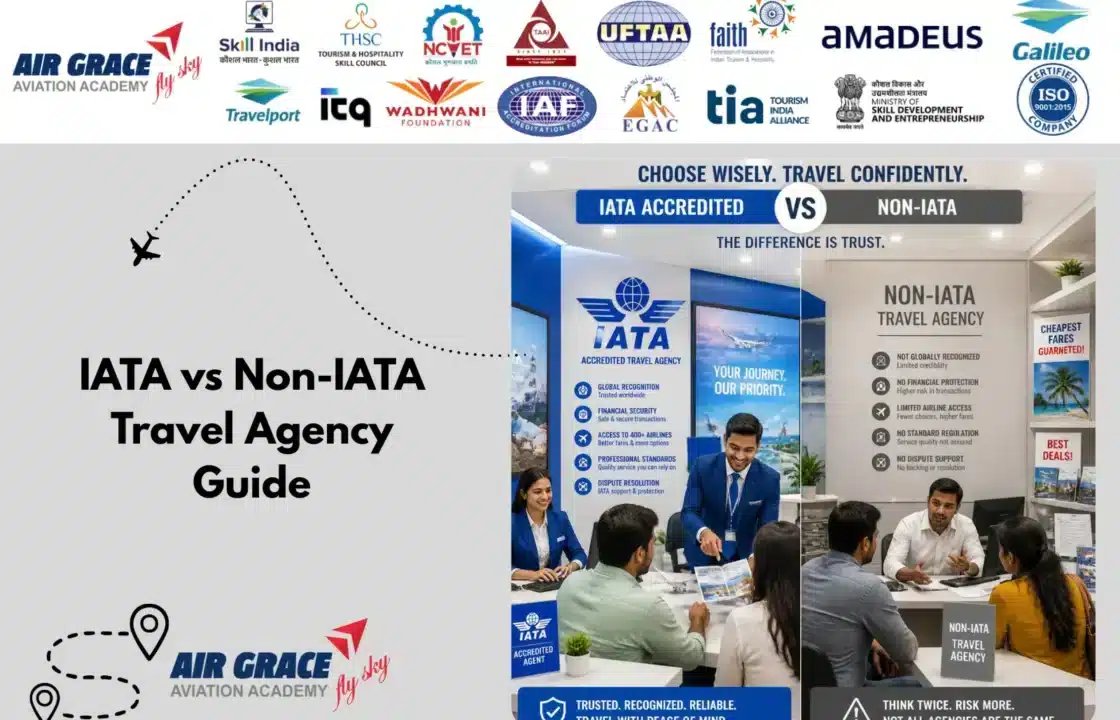
IATA vs Non-IATA Travel Agency: Complete Guide for Travel Entrepreneurs
Starting a travel agency is one of the most exciting opportunities in today’s growing tourism and aviation industr …