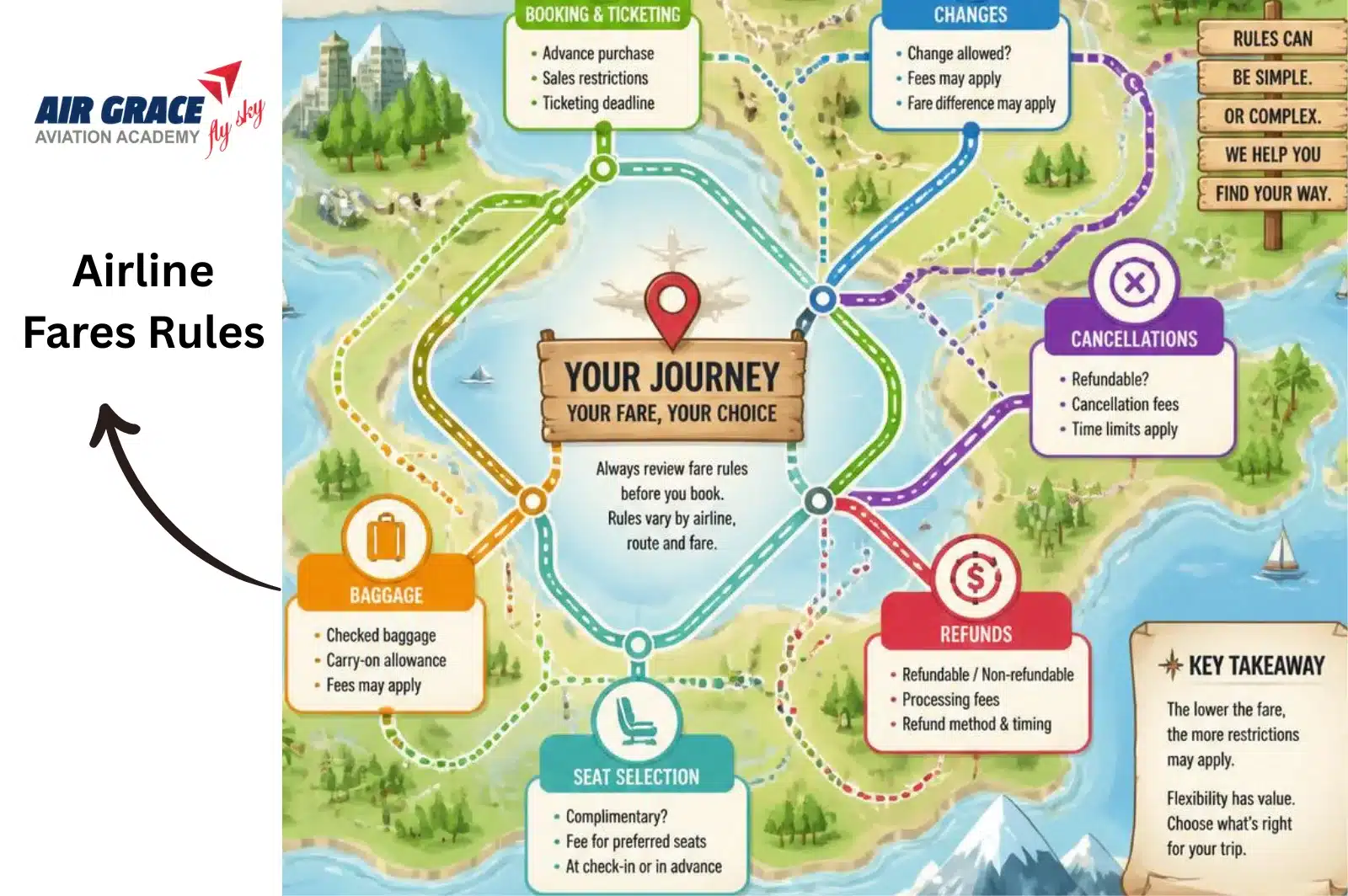
Understanding airline fare rules is one of the most important skills for anyone working in the aviation and travel industry. Whether you are a travel consultant, airline reservation executive, or simply a frequent traveler, knowing how fare rules work can help avoid costly mistakes, unexpected penalties, and customer complaints.
At Air Grace Aviation Academy, New Delhi, students receive practical training on interpreting airline fare rules using Amadeus GDS, Galileo GDS, and Sabre GDS, preparing them for careers in airlines, travel agencies, OTAs, and corporate travel management.
This comprehensive guide explains airline fare rules in simple language while helping aspiring travel professionals gain industry knowledge.
What Are Airline Fare Rules?
Airline fare rules are the conditions attached to every airline ticket that specify how the ticket can be used. These rules determine:
- Ticket validity
- Refund eligibility
- Cancellation charges
- Date change policy
- Flight change conditions
- Stopover permissions
- Minimum and maximum stay
- Baggage allowance
- No-show penalties
- Reissue charges
- Fare upgrades
Every airfare published by an airline comes with its own unique set of fare conditions.
Why Are Airline Fare Rules Important?
Fare rules protect both airlines and passengers by clearly defining what is allowed after purchasing a ticket.
Benefits include:
- Preventing booking mistakes
- Understanding cancellation penalties
- Knowing refund eligibility
- Managing flight changes correctly
- Avoiding unexpected airline charges
- Helping travel agents provide accurate customer information
- Ensuring compliance with airline policies
For travel professionals, reading fare rules correctly is a daily responsibility.
How Do Airline Fare Rules Work?
Whenever an airline publishes a fare, it creates a detailed list of conditions linked to that fare.
These conditions may include:
| Fare Rule Category | Description |
|---|---|
| Advance Purchase | Days before departure required for booking |
| Refund Rule | Whether ticket is refundable |
| Cancellation Rule | Penalty applicable on cancellation |
| Date Change | Charges for modifying travel date |
| Flight Change | Conditions for changing flights |
| Stopover | Whether stopovers are permitted |
| Minimum Stay | Minimum days passenger must stay |
| Maximum Stay | Maximum validity of ticket |
| No Show | Charges if passenger misses flight |
| Baggage | Checked and cabin baggage allowance |
| Ticket Validity | How long ticket remains valid |
Types of Airline Fare Rules
1. Refundable Fare
Refundable tickets allow passengers to cancel their journey and receive a refund.
Advantages:
- Flexible travel
- Lower cancellation losses
- Suitable for business travelers
Disadvantages:
- Higher ticket price
2. Non-Refundable Fare
These tickets usually cannot be refunded after purchase.
However, airport taxes may still be refundable depending on airline policy.
Ideal for:
- Leisure travelers
- Budget travel
- Promotional fares
3. Partially Refundable Fare
Some airlines deduct cancellation penalties and refund the remaining balance.
Example:
Ticket Price:
₹12,000
Cancellation Charge:
₹3,000
Refund:
₹9,000
4. Promotional Fare
Promotional fares are offered during sales or special campaigns.
Characteristics:
- Lowest airfare
- Limited availability
- Strict cancellation rules
- Often non-refundable
- Limited changes allowed
5. Corporate Fare
Corporate fares are designed for companies and business travelers.
Benefits include:
- Flexible ticket changes
- Reduced cancellation charges
- Higher baggage allowance
- Priority services
Understanding Fare Basis Codes
Every airline ticket contains a Fare Basis Code, which helps identify the type of fare purchased.
Example:
- Y
- M
- K
- Q
- V
- L
- T
These letters indicate booking classes and associated fare conditions.
Travel consultants learn to interpret these codes during professional airline reservation training.
Common Airline Fare Restrictions
Different fare classes come with different restrictions.
Some common restrictions include:
- No refund allowed
- Date change with penalty
- Flight change before departure only
- Weekend travel restrictions
- Seasonal restrictions
- Blackout travel dates
- Advance purchase requirements
- Minimum stay conditions
Always review fare rules before issuing a ticket.
What Is an Advance Purchase Rule?
Many discounted fares require tickets to be booked several days before departure.
Examples include:
- Purchase 7 days before travel
- Purchase 14 days before travel
- Purchase 21 days before travel
- Purchase 30 days before travel
Booking too late may result in higher airfare.
Minimum Stay Rule
Some international fares require passengers to remain at the destination for a minimum period.
Examples:
- Stay at least 3 days
- Stay until Sunday
- Stay for 7 days
This prevents misuse of discounted business fares.
Maximum Stay Rule
Airlines also limit the maximum period a passenger can remain at the destination.
Examples:
- Maximum stay 1 month
- Maximum stay 3 months
- Maximum stay 6 months
- Maximum stay 1 year
Date Change Rules
One of the most frequently asked customer questions is whether travel dates can be changed.
The answer depends on fare conditions.
Possible scenarios:
- Free date change
- Date change with airline penalty
- Date change plus fare difference
- Date change not permitted
Travel consultants verify these rules before making modifications.
Flight Change Rules
Changing flights is different from changing dates.
Passengers may:
- Change departure time
- Change connecting flight
- Change routing
- Upgrade travel class
Whether these changes are allowed depends on the purchased fare.
Cancellation Rules
Cancellation policies vary across airlines and fare types.
Common policies include:
- Free cancellation within 24 hours
- Fixed cancellation fee
- Percentage-based deduction
- No refund after departure
- Non-refundable promotional tickets
Understanding cancellation rules helps reduce customer disputes.
No-Show Policy
A no-show occurs when a passenger fails to board the flight without cancelling beforehand.
Consequences may include:
- Entire ticket forfeited
- Higher rebooking charges
- Loss of refund eligibility
- Additional airline penalties
Many airlines impose separate no-show fees in addition to cancellation charges.
Baggage Rules
Fare rules also specify baggage entitlement.
They include:
- Cabin baggage
- Checked baggage
- Extra baggage fees
- Sports equipment policy
- Infant baggage
- Oversized baggage
Different fare families often include different baggage allowances.
Stopover Rules
A stopover occurs when a passenger stays at an intermediate city for more than the permitted transit time.
Some fares:
- Allow free stopovers
- Allow paid stopovers
- Do not permit stopovers
This rule is especially important in international travel planning.
Ticket Validity
Ticket validity depends on fare type.
Examples include:
- Valid for one month
- Valid for three months
- Valid for one year
Unused tickets generally expire after the validity period unless fare rules permit extensions.
Why Travel Agents Must Read Fare Rules Carefully
Professional travel consultants always check fare rules before issuing tickets because incorrect advice can lead to:
- Financial loss
- Customer dissatisfaction
- Airline debit memos
- Reissue complications
- Refund disputes
Reading fare rules is considered one of the most essential skills in airline ticketing.
How Fare Rules Are Viewed in Amadeus GDS
In Amadeus GDS, fare rules can be displayed directly after pricing an itinerary.
Travel professionals review:
- Refund conditions
- Reissue rules
- Cancellation penalties
- Seasonal restrictions
- Baggage allowances
- Advance purchase requirements
- Routing rules
Students at Air Grace Aviation Academy receive practical training on reading and interpreting these fare rules using live GDS simulations.
Career Opportunities After Learning Airline Fare Rules
Professionals skilled in fare rules are highly valued by:
- Airlines
- Travel agencies
- Online Travel Agencies (OTAs)
- Corporate travel companies
- Airport ticketing offices
- Tour operators
- Business travel management firms
- Global reservation centers
Common job roles include:
- Air Ticketing Executive
- Reservation Executive
- Travel Consultant
- GDS Executive
- Corporate Travel Executive
- Airline Customer Service Executive
Learn Airline Fare Rules with Air Grace Aviation Academy
If you want to build a successful career in aviation or travel, mastering airline fare rules is essential.
At Air Grace Aviation Academy, located at 5th Floor, 514, Barakhamba Road, Connaught Place, New Delhi, students receive industry-oriented training in:
- IATA Air Ticketing
- Domestic & International Reservations
- Amadeus GDS
- Galileo GDS
- Sabre GDS
- Airline Fare Rules
- PNR Creation
- Ticket Reissue
- Refund & Cancellation Procedures
- Visa Documentation
- Travel & Tourism Management
Our expert trainers provide practical, job-focused instruction to help students become confident travel professionals.
Call for Free Career Counselling: +91 8527446364
Frequently Asked Questions (FAQs)
What are airline fare rules?
Airline fare rules are the conditions attached to an airline ticket that determine refunds, cancellations, date changes, baggage allowance, stopovers, and ticket validity.
Can airline fare rules differ for the same flight?
Yes. Passengers on the same flight may have different fare rules depending on the fare class and ticket type purchased.
Are all airline tickets refundable?
No. Many promotional and economy fares are non-refundable, while flexible fares may allow full or partial refunds.
Why should travel agents understand fare rules?
Travel agents use fare rules to advise customers correctly, process changes accurately, and avoid booking errors that can result in financial losses.
Where can I learn airline fare rules professionally?
Air Grace Aviation Academy in New Delhi offers practical training in airline fare rules, Amadeus GDS, Galileo GDS, Sabre GDS, and IATA air ticketing to prepare students for careers in the travel and aviation industry.
Conclusion
Airline fare rules form the foundation of professional air ticketing and travel management. From refunds and cancellations to baggage allowances and ticket validity, every airline ticket is governed by a unique set of conditions. Understanding these rules enables travel professionals to provide accurate guidance, minimize errors, and deliver exceptional customer service.
If you’re looking to start or advance your career in the aviation and travel industry, learning airline fare rules through hands-on training at Air Grace Aviation Academy can give you the practical skills employers value.

Related posts
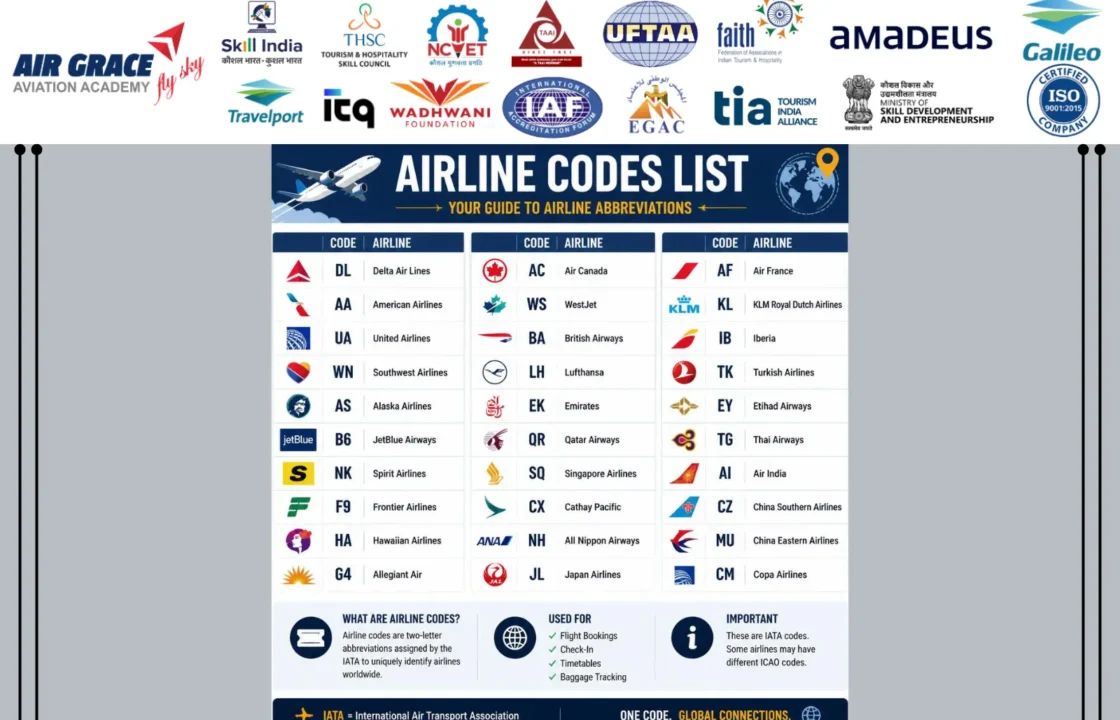
Airline Codes List
Complete IATA & ICAO Airline Codes Guide for Aviation & Travel Professionals If you have ever looked at an airlin …
What is GDS? Complete Guide to the Global Distribution System in the Travel & Aviation Industry (2026)
What is GDS? If you have ever booked a flight through a travel agency, compared airline fares online, or wondered how tra …