IATA Agency Benefits: The Complete Guide to Growing Your Travel Agency
Running a successful travel agency today requires more than just selling flight tickets. Customers expect reliability, transparency, professional service, and secure booking processes. Airlines also prefer working with agencies that meet internationally recognized standards.
This is where IATA Accreditation becomes valuable.
Understanding IATA agency benefits can help travel entrepreneurs make informed decisions about expanding their business. Whether you operate a new agency or an established travel company, becoming an IATA Accredited Travel Agency can strengthen your professional reputation, improve operational efficiency, and open doors to new business opportunities.
In this comprehensive guide, you’ll learn what IATA accreditation is, why it matters, who should apply, and the major benefits it offers to travel agencies in India and around the world.
What is IATA?
The International Air Transport Association (IATA) is a global trade association that works with airlines and the travel industry to support safe, secure, and standardized air transportation.
IATA develops industry standards, promotes best practices, and provides programs that help airlines and accredited travel agencies work together efficiently.
Today, thousands of airlines, travel agencies, airports, and travel businesses operate within frameworks supported by IATA.
What is an IATA Accredited Travel Agency?
An IATA Accredited Travel Agency is a travel business that has successfully met IATA’s accreditation requirements and has been recognized under one of its accreditation programs.
Accreditation demonstrates that the agency operates professionally and follows established industry standards.
Depending on the agency’s business model and eligibility, accreditation may provide access to industry processes and programs that support airline distribution and business operations.
Why Does IATA Accreditation Matter?
In today’s competitive travel industry, customers often compare multiple agencies before making a booking. They look for agencies that appear reliable, knowledgeable, and trustworthy.
IATA accreditation helps demonstrate that an agency has met recognized industry requirements.
For travel businesses, accreditation can contribute to:
- Stronger professional credibility
- Increased customer confidence
- Better business recognition
- Improved operational standards
- Access to industry programs and services (subject to eligibility)
While accreditation does not guarantee business success, it can strengthen an agency’s position in the marketplace.
Why More Travel Agencies Are Choosing IATA Accreditation
The travel industry has become increasingly competitive.
Customers expect:
- Professional service
- Accurate flight information
- Secure payment processes
- Reliable travel support
- Quick issue resolution
Agencies that invest in professional systems, trained staff, and recognized standards are often better positioned to meet these expectations.
As a result, many travel businesses choose to pursue IATA accreditation as part of their long-term growth strategy.
Top IATA Agency Benefits
Let’s explore some of the most important benefits.
1. Enhanced Professional Credibility
One of the biggest advantages of IATA accreditation is the professional image it creates.
When customers see that a travel agency has achieved recognized industry accreditation, they may feel more confident booking flights and travel services.
Professional credibility can contribute to:
- Greater customer trust
- Improved business reputation
- Stronger brand positioning
- Increased confidence among corporate clients
Trust is particularly important when customers are booking international travel or high-value itineraries.
2. Stronger Customer Confidence
Customers often spend significant amounts on travel.
They want reassurance that:
- Their bookings are handled professionally.
- Their travel documents are prepared correctly.
- They can receive assistance if travel plans change.
Operating under recognized industry standards can help agencies build long-term customer relationships through consistent service quality.
3. Better Brand Recognition
An accredited agency often enjoys stronger recognition within the travel industry.
This can help when working with:
- Corporate clients
- Business travelers
- Tour operators
- Hospitality partners
- International travel partners
Professional recognition can support long-term business development and networking opportunities.
4. Competitive Advantage
Thousands of travel agencies compete for customers every day.
Professional accreditation can help an agency differentiate itself by highlighting its commitment to recognized industry standards and continuous improvement.
While customers consider many factors before booking, a strong professional profile can positively influence purchasing decisions.
5. Business Growth Opportunities
As agencies expand, they often look for ways to improve efficiency, strengthen partnerships, and reach new customer segments.
IATA accreditation may support business growth by:
- Enhancing professional credibility
- Supporting corporate business development
- Improving operational confidence
- Demonstrating commitment to industry standards
Growth ultimately depends on business strategy, customer service, and market conditions, but accreditation can be an important part of that journey.
Accredited vs Non-Accredited Travel Agency
Many new entrepreneurs ask whether accreditation makes a difference.
The following comparison highlights some general distinctions.
| IATA Accredited Agency | Non-Accredited Agency |
|---|---|
| Operates under recognized accreditation standards | May operate without industry accreditation |
| Demonstrates commitment to professional processes | Professional standards vary by business |
| Can enhance customer confidence | Customer trust depends primarily on reputation |
| May qualify for certain IATA programs, subject to eligibility | Access depends on business arrangements |
| Builds stronger professional positioning | Growth relies on individual business development |
Accreditation is one element of a successful business and should be combined with excellent customer service, knowledgeable staff, and sound business practices.
Who Should Apply for IATA Accreditation?
IATA accreditation may be suitable for:
- New travel agencies
- Established travel companies
- Corporate travel management firms
- Tour operators
- Online travel agencies (OTAs)
- International travel specialists
- Entrepreneurs planning to expand their travel business
Before applying, agencies should review the current eligibility requirements and determine which accreditation program best fits their business model.
Is IATA Accreditation Only for Large Agencies?
No.
Many entrepreneurs assume that only large travel companies can pursue accreditation.
In reality, IATA offers different programs designed to support agencies at various stages of growth, subject to meeting the applicable eligibility criteria.
Choosing the right program depends on factors such as business size, operations, and long-term goals.
How IATA Accreditation Supports Business Development
While accreditation is not a guarantee of increased revenue, it can contribute to business development in several ways:
- Demonstrating professionalism
- Strengthening business credibility
- Supporting customer confidence
- Improving market positioning
- Encouraging operational best practices
Combined with quality service and effective marketing, these factors can help agencies compete more effectively.
Common Misconceptions About IATA Accreditation
Many travel entrepreneurs have questions about accreditation.
Myth 1: Only international agencies can become accredited.
Reality: Agencies from many countries, including India, can apply if they meet the applicable requirements.
Myth 2: Accreditation guarantees instant business success.
Reality: Success depends on multiple factors, including customer service, marketing, pricing, operational efficiency, and business strategy.
Myth 3: Small agencies cannot qualify.
Reality: Different accreditation programs are available for agencies with different business models and stages of development, subject to eligibility.
Myth 4: Accreditation replaces business skills.
Reality: Accreditation complements good business practices—it does not replace professional management, trained staff, or excellent customer service.
Why India Is a Strong Market for IATA Accredited Agencies
India’s travel industry continues to grow due to:
- Increasing domestic tourism
- Rising international travel
- Expanding airline networks
- Growth in corporate travel
- Digital booking platforms
- Government focus on tourism infrastructure
As competition increases, agencies that invest in professional training, operational excellence, and recognized standards may strengthen their market position.
Travel businesses in Delhi, New Delhi, Noida, Gurugram, Ghaziabad, Faridabad, Jaipur, Chandigarh, Lucknow, Mumbai, Bengaluru, Hyderabad, Pune, Kolkata, Chennai, and across India are increasingly exploring accreditation as part of their long-term growth plans.
Why Professional Guidance Matters
Applying for IATA accreditation involves understanding documentation, eligibility criteria, compliance requirements, and application procedures.
Working with experienced professionals can help agencies:
- Understand the accreditation process
- Prepare required documentation
- Avoid common application mistakes
- Save time during the preparation phase
- Build confidence before submission
Proper preparation improves the overall application experience.
How IATA Accreditation Supports Long-Term Business Growth
However, the real value of becoming an IATA Accredited Travel Agency goes much deeper. Accreditation can support better business operations, strengthen relationships within the travel industry, and help agencies prepare for long-term growth.
For agencies planning to expand beyond basic flight bookings, understanding these benefits is essential.
1. Stronger Position in the Travel Industry
The travel industry is built on trust and professional relationships. Airlines, travel suppliers, corporate clients, and customers prefer working with agencies that maintain organized business practices.
IATA accreditation demonstrates that an agency has met recognized industry requirements and is committed to maintaining professional standards.
Over time, this can help strengthen the agency’s reputation within the travel ecosystem.
2. Improved Business Credibility with Corporate Clients
Corporate organizations often look for reliable travel partners that can manage business travel efficiently.
When approaching corporate clients, agencies benefit from presenting:
- Professional business operations
- Industry-recognized accreditation
- Knowledge of airline reservation systems
- Experienced travel consultants
- Efficient travel management processes
While every organization has its own vendor selection criteria, accreditation can contribute positively to an agency’s professional profile.
3. Understanding BSP (Billing and Settlement Plan)
One of the most commonly discussed topics in travel agency accreditation is the Billing and Settlement Plan (BSP).
BSP is a system developed by IATA that simplifies the financial settlement process between participating airlines and accredited travel agencies in markets where BSP operates.
Instead of managing separate financial settlements with multiple participating airlines individually, eligible agencies can use the BSP framework according to applicable market rules.
Why BSP Is Important
Without a centralized settlement process, managing transactions across multiple participating airlines can become more complex.
Where applicable, BSP helps streamline:
- Financial reporting
- Settlement processes
- Administrative workflows
- Standardized documentation
The exact availability and functionality of BSP depend on the country, airline participation, and the agency’s accreditation status.
4. Better Operational Efficiency
Professional travel agencies handle multiple tasks every day, including:
- Flight reservations
- Ticket issuance
- Schedule changes
- Refund requests
- Customer communication
- Documentation
Accreditation encourages agencies to adopt structured operational practices that support accuracy and consistency.
Well-organized processes can improve productivity and customer service.
5. Access to IATA Programs
IATA offers different accreditation programs designed to support travel agencies with varying business models and operational needs.
Some of the commonly known programs include:
- IATA GoLite
- IATA GoStandard
- IATA GoGlobal
Each program has its own eligibility requirements, features, and intended use cases.
Choosing the appropriate option depends on factors such as business size, operational model, target markets, and long-term objectives.
Understanding IATA GoLite
GoLite is designed for agencies seeking an entry pathway into IATA accreditation while meeting the applicable eligibility requirements.
Depending on the market and program structure, it may suit agencies that are:
- Expanding their operations
- Building professional credibility
- Preparing for future growth
Business owners should review the latest program requirements before applying.
Understanding IATA GoStandard
GoStandard is intended for agencies that require a broader accreditation framework aligned with their business activities.
Depending on eligibility and operational requirements, it may support agencies with more established travel operations.
Understanding IATA GoGlobal
For travel businesses operating across multiple markets, GoGlobal is designed to support organizations with international operations, subject to program eligibility and applicable requirements.
Agencies should evaluate which accreditation pathway aligns best with their business goals.
6. Better Customer Retention
Winning a customer is important, but retaining that customer is even more valuable.
Customers are more likely to return to agencies that consistently provide:
- Accurate reservations
- Professional communication
- Reliable travel assistance
- Efficient issue resolution
- Transparent service
Accreditation complements these qualities by reinforcing an agency’s commitment to recognized industry standards.
7. Increased Opportunities for Business Expansion
As agencies grow, they often diversify their services.
Many successful travel businesses expand into areas such as:
- Corporate travel
- Group travel
- International holiday packages
- MICE (Meetings, Incentives, Conferences, and Exhibitions)
- Luxury travel
- Religious tourism
- Educational tours
- Medical tourism
Professional systems and standardized processes can help support this growth.
8. Better Staff Development
A successful travel agency depends on knowledgeable professionals.
Many agencies invest in training employees in areas such as:
- Airline reservation systems
- Global Distribution Systems (GDS)
- Fare calculation
- Passenger Name Record (PNR) management
- Customer service
- Visa documentation
Well-trained teams improve operational accuracy and customer satisfaction.
9. Increased Confidence When Working with Airlines
Travel agencies regularly interact with airlines for reservations, schedule changes, fare inquiries, and customer support.
Understanding airline procedures and maintaining professional operations helps agencies build productive working relationships.
Strong operational knowledge benefits both the agency and its customers.
10. Better Prepared for Industry Changes
The travel industry evolves continuously.
Examples include:
- New airline policies
- Technology updates
- Reservation system enhancements
- Digital payment solutions
- Customer service innovations
Agencies that invest in continuous learning and professional development are generally better prepared to adapt to industry changes.
Common Business Challenges Solved Through Professional Processes
Travel agencies often face challenges such as:
- Booking errors
- Fare misunderstandings
- Documentation mistakes
- Schedule changes
- Customer complaints
- Payment tracking
- Reservation management
Establishing structured workflows and training staff thoroughly can help reduce these issues.
Why Professional Training Matters Before Applying for IATA Accreditation
Many entrepreneurs focus only on obtaining accreditation.
However, long-term success depends on understanding how to operate a travel agency professionally.
Important areas include:
- Air Ticketing
- Airline Reservations
- Amadeus GDS
- Galileo GDS
- Passenger Name Record (PNR)
- Fare Rules
- Refund Procedures
- Reissue Procedures
- Visa Documentation
- Customer Service
A knowledgeable team can maximize the benefits of accreditation by delivering high-quality service.
Practical Example
Imagine two travel agencies opening in Delhi.
Agency A
- No structured reservation process
- Limited airline knowledge
- No standardized documentation
- Minimal staff training
Agency B
- Professionally trained team
- Strong reservation procedures
- GDS knowledge
- Well-organized workflows
- Focus on customer service
- Pursues recognized industry standards
Over time, Agency B is generally better positioned to deliver consistent service, build customer trust, and support sustainable growth.
Why Delhi Is an Ideal Location for Travel Agencies
Delhi is one of India’s largest aviation and travel markets.
Travel businesses in Connaught Place, Karol Bagh, Nehru Place, Janakpuri, Dwarka, Rohini, Laxmi Nagar, Noida, Gurugram, Ghaziabad, Faridabad, and across Delhi NCR benefit from access to:
- Domestic and international travelers
- Corporate clients
- Tourism businesses
- Airline offices
- Hospitality companies
- Government organizations
- Business events
This makes Delhi an attractive location for entrepreneurs planning to establish or expand a travel agency.
Key Takeaways
IATA accreditation is not simply a certificate; it can be part of a broader strategy for building a professional travel business.
Combined with practical knowledge, efficient processes, and excellent customer service, it can support:
- Stronger business credibility
- Better operational organization
- Improved customer confidence
- Business growth opportunities
- Professional industry recognition
- Long-term development
How to Become an IATA Accredited Travel Agency
After understanding the benefits of IATA accreditation, the next question most travel entrepreneurs ask is:
“How do I become an IATA Accredited Travel Agency?”
The accreditation process involves more than submitting an application. Travel businesses should ensure they meet the applicable eligibility requirements, maintain proper documentation, and understand the operational responsibilities associated with accreditation.
Although specific requirements can change over time and may vary depending on the accreditation program and country, the overall process generally follows a structured path.
Step-by-Step IATA Accreditation Process
Step 1: Evaluate Your Business
Before applying, assess your agency’s readiness.
Consider questions such as:
- Is your business legally registered?
- Do you have a professional office setup?
- Are your financial records organized?
- Do you have trained staff?
- Is your business prepared to meet ongoing compliance requirements?
Preparing in advance can help reduce delays during the application process.
Step 2: Choose the Right Accreditation Program
IATA offers different accreditation pathways designed for different business models.
Depending on your agency’s size, operations, and objectives, you may explore:
- IATA GoLite
- IATA GoStandard
- IATA GoGlobal
Each program has its own eligibility criteria and operational requirements. Choosing the right option is an important part of the planning process.
Step 3: Prepare Required Documentation
Documentation requirements may vary based on the accreditation program and your country.
Commonly requested business documents can include:
- Business registration documents
- Office address proof
- Identity documents of business owners or directors
- Financial information
- Tax registration details
- Bank account information
- Company profile
- Operational details
Always refer to the latest official IATA requirements for your market before submitting an application.
Step 4: Submit Your Application
Once your documents are complete and your agency is ready, you can submit the application through the appropriate IATA accreditation process.
Carefully review all information before submission to minimize errors and avoid unnecessary delays.
Step 5: Complete the Review Process
IATA reviews applications based on its current policies, eligibility criteria, and documentation requirements.
During this stage, applicants may be asked to provide additional information or clarification.
Responding promptly can help keep the process moving smoothly.
Step 6: Maintain Professional Standards
Accreditation is not only about receiving approval. Agencies should continue to:
- Follow industry best practices
- Maintain accurate records
- Train employees
- Keep business information up to date
- Comply with applicable accreditation requirements
Continuous improvement supports long-term business success.
Common Mistakes Travel Agencies Should Avoid
Many agencies delay their accreditation because of avoidable mistakes.
Some of the most common include:
Incomplete Documentation
Missing or inaccurate documents can slow down the application process.
Lack of Industry Knowledge
Business owners who are unfamiliar with airline reservations, ticketing procedures, or travel operations may face operational challenges after accreditation.
Professional training can help bridge these knowledge gaps.
Poor Financial Planning
Agencies should understand the financial responsibilities associated with operating a professional travel business before applying for accreditation.
Choosing the Wrong Accreditation Path
Not every accreditation option is suitable for every business.
Selecting a program that aligns with your business model and future goals is important.
Ignoring Staff Training
Well-trained employees contribute to:
- Better customer service
- Fewer booking errors
- More efficient operations
- Improved business performance
Investing in employee development benefits both the agency and its customers.
Why Professional Guidance Can Help
The accreditation process involves documentation, planning, and understanding industry requirements.
Working with experienced consultants can help agencies:
- Understand eligibility requirements
- Prepare documentation
- Organize application materials
- Avoid common mistakes
- Improve readiness before applying
Professional guidance can simplify the preparation process, particularly for first-time applicants.
Why Travel Agency Training Matters
Many entrepreneurs focus only on obtaining accreditation.
However, successful agencies also require practical operational knowledge.
Important areas include:
- Air Ticketing
- Passenger Name Record (PNR) Management
- Amadeus GDS
- Galileo GDS
- Sabre GDS
- Fare Rules
- Electronic Ticketing
- Reissue Procedures
- Refund Management
- Visa Documentation
- Customer Service
A skilled team is essential for delivering quality travel services and supporting long-term business growth.
Why Air Grace Aviation Academy?
Air Grace Aviation Academy provides practical training and consultancy services designed to support travel professionals and travel agencies.
Our focus is on helping agencies develop the knowledge and skills required to operate confidently within the travel industry.
Our Services Include
- IATA Accreditation Consultancy
- Guidance on IATA GoLite, GoStandard & GoGlobal pathways
- Air Ticketing Training
- Amadeus GDS Training
- Galileo GDS Training
- Sabre GDS Training
- Passenger Name Record (PNR) Management
- Fare Rules & Ticketing Procedures
- Visa Documentation Training
- Travel Agency Operations Training
Whether you are starting a new agency or expanding an existing one, practical industry knowledge can support your business goals.
Why Travel Agencies Across India Choose Professional Consultancy
Travel businesses from Delhi, New Delhi, Noida, Gurugram, Ghaziabad, Faridabad, Jaipur, Chandigarh, Lucknow, Mumbai, Pune, Bengaluru, Hyderabad, Chennai, Kolkata, Ahmedabad, and other cities across India seek professional guidance to better understand accreditation requirements and prepare their businesses for growth.
Experienced support can help agencies navigate the process more efficiently while reducing common application errors.
Frequently Asked Questions (FAQs)
What is an IATA Accredited Travel Agency?
An IATA Accredited Travel Agency is a travel business that has met the applicable IATA accreditation requirements and has been approved under one of IATA’s accreditation programs.
What are the benefits of IATA accreditation?
Benefits may include stronger professional credibility, increased customer confidence, access to certain industry programs (subject to eligibility), and improved business recognition.
Is IATA accreditation mandatory for every travel agency?
No. Many travel agencies operate without IATA accreditation. Whether accreditation is appropriate depends on the agency’s business model, objectives, and operational needs.
Can a new travel agency apply for IATA accreditation?
Depending on the accreditation program and eligibility requirements, new agencies may be able to apply after meeting the necessary criteria.
What is the difference between GoLite, GoStandard, and GoGlobal?
These are different IATA accreditation pathways designed for different business models and operational requirements. Agencies should review the latest eligibility criteria to determine which option best suits their needs.
How long does the accreditation process take?
Processing times vary depending on factors such as documentation completeness, review requirements, and the applicable accreditation program.
Do I need GDS knowledge before applying?
While not always a formal requirement, practical knowledge of reservation systems such as Amadeus, Galileo, or Sabre can help agencies operate more efficiently after accreditation.
Can IATA accreditation guarantee business success?
No. Accreditation is an important professional milestone, but business success also depends on customer service, marketing, operational excellence, pricing, and effective management.
Related Topics You Should Learn
If you’re planning to establish or grow a travel agency, these subjects can strengthen your knowledge:
- How to Start a Travel Agency in India
- What is BSP?
- What is PNR?
- GDS Commands
- Amadeus Commands
- Galileo GDS Guide
- Airline Fare Rules
- Air Ticketing Process
- Visa Documentation
- Travel Agency Business Plan
Together, these topics provide a solid foundation for running a professional travel business.
Final Thoughts
The benefits of IATA accreditation extend beyond recognition. For many travel agencies, accreditation forms part of a broader strategy focused on professionalism, operational efficiency, and long-term business growth.
When combined with practical training, strong customer service, and sound business practices, IATA accreditation can help agencies strengthen their position in an increasingly competitive travel industry.
Whether you are launching your first travel agency or expanding an established business, understanding the accreditation process and investing in professional skills can support sustainable success.
🚀 Grow Your Travel Agency with Air Grace Aviation Academy
Looking to build a stronger travel business or prepare for IATA Accreditation?
Air Grace Aviation Academy offers practical training and consultancy services for aspiring and established travel agencies across India.
Our Expertise
- ✅ IATA Accreditation Consultancy
- ✅ Guidance for GoLite, GoStandard & GoGlobal
- ✅ Air Ticketing & Airline Reservations
- ✅ Amadeus, Galileo & Sabre GDS Training
- ✅ Passenger Name Record (PNR) Management
- ✅ Airline Fare Rules
- ✅ Visa Documentation
- ✅ Travel Agency Operations
- ✅ Staff Training
- ✅ Business Support for Travel Entrepreneurs
📍 Visit Us
Air Grace Aviation Academy
5th Floor, 514, Barakhamba Road, Connaught Place, New Delhi – 110001
📞 Call / WhatsApp
+91-8527446364
If you’re searching for IATA Accreditation Consultancy in Delhi, IATA Agency Registration Support, Travel Agency Training, or IATA GoLite, GoStandard, and GoGlobal guidance, Air Grace Aviation Academy is committed to helping travel professionals build practical skills and prepare for long-term success.
Start your journey toward a stronger, more professional travel business with expert guidance and industry-focused training.

Related posts
Career in Travel and Tourism: Complete Guide to Jobs, Salary, Courses & Future Scope
Career in Travel and Tourism: Your Gateway to a Global Industry The travel and tourism industry is one of the world’ …
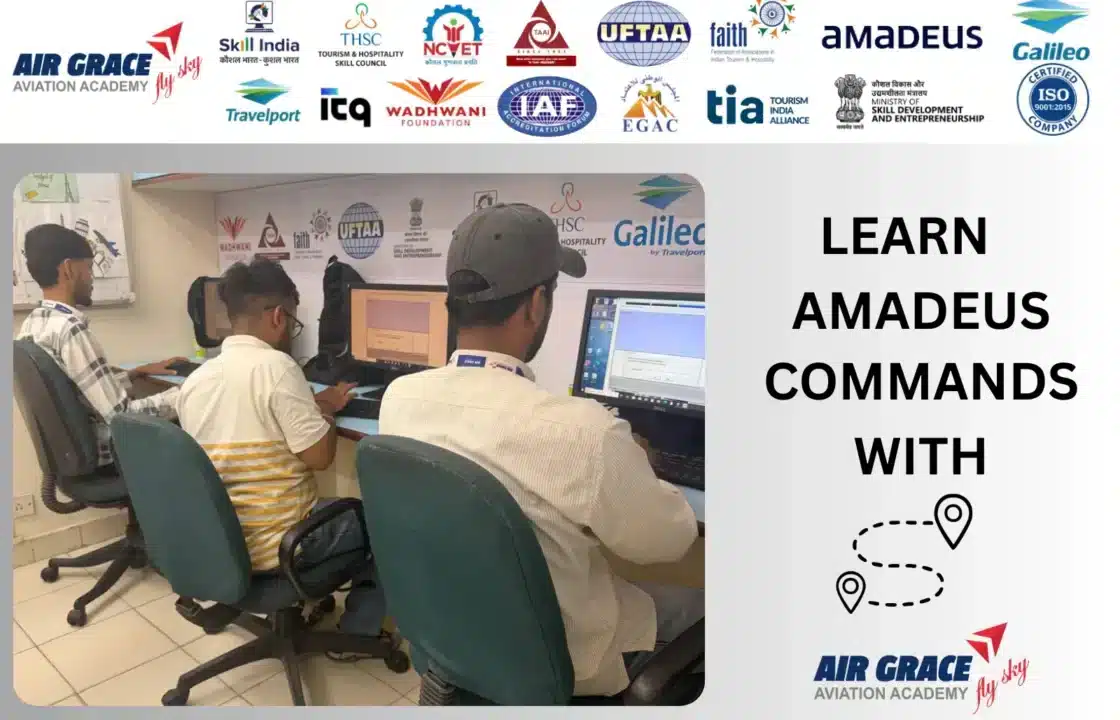
Amadeus Commands with Examples – Complete Guide for Beginners
Amadeus Commands with Examples Learn the World’s Leading Airline Reservation System If you want to build a successf …